Red Henna: the red-brown stain natural henna really makes, why red and pink cones are something else, and how henna turns hair red
Red henna explained: natural henna stains skin orange to reddish brown and hair orange to burgundy. Red, pink and blue cones need other ingredients.

Written by Sukie
, updated November 21, 2026
General information, not medical advice. Patch-test any paste or dye first, and see a doctor if your skin reacts (signs: American Academy of Dermatology).
Ask for red henna and you could mean two different things. On skin, natural henna never stains true red: it starts orange and darkens to a reddish brown over one to three days. Bright red, pink or blue "henna" cones get their color from other ingredients. On hair, pure henna gives a real red, from orange to auburn to burgundy, depending on your starting shade.
That split matters, because the same two words sell a plant that has been used for centuries and a colored paste with an unknown recipe. This page separates them. It shows what the natural stain looks like hour by hour, what the FDA says about colors henna cannot make, how the alternatives compare, and how to get red hair from henna without guessing. For the basics of the plant, start with the henna guide. For cones, powders and kits that pass our natural test, the henna kit hub has the full list, and henna cones covers how to read a cone label. The products just below are natural body-art cones only. We do not list red, pink, black or multi-color cone kits anywhere on this site.
Natural body-art henna cones: the reddish-brown stain, nothing added for color
Chosen from Amazon's best-rated, best-selling listings, then checked against the ingredient list. Prices refresh daily.

Plantovika Henna Cones Made from 100% Natural Leaves | Fresh Ready-to-Use Pre-Filled Paste, Henna Tube | Dark Reddish Brown | No Additives | Long Lasting Color | Pack of 6
$8.49
as of Nov 24, 2026

Organic Leaves - Henna Cones 3 × 30 g Pack | Made from 100% Natural Henna Leaves | Ready-to-Use, Pre-Filled Cones | 5-Stage Filtered for Rich, Long-Lasting Color | Chemical-Free & Premium Quality
$7.59
as of Nov 24, 2026

Plantovika Henna Cones Made from 100% Natural Leaves | Fresh Ready-to-Use Pre-Filled Paste, Henna Tube | Dark Reddish Brown | No Additives | Long Lasting Color | Pack of 12
$12.74
as of Nov 24, 2026
Affiliate links. Product prices and availability are accurate as of Nov 24, 2026 and are subject to change. Disclosure at the end of the page.
What "red henna" means: one name, two products
Henna is the powdered leaf of Lawsonia inermis. Its dye, lawsone, is described in Wikipedia's lawsone entry as a red-orange dye that binds to keratin, the protein in skin and hair. So "red" is not wrong as a description of henna. It is just a different red in each place it lands.
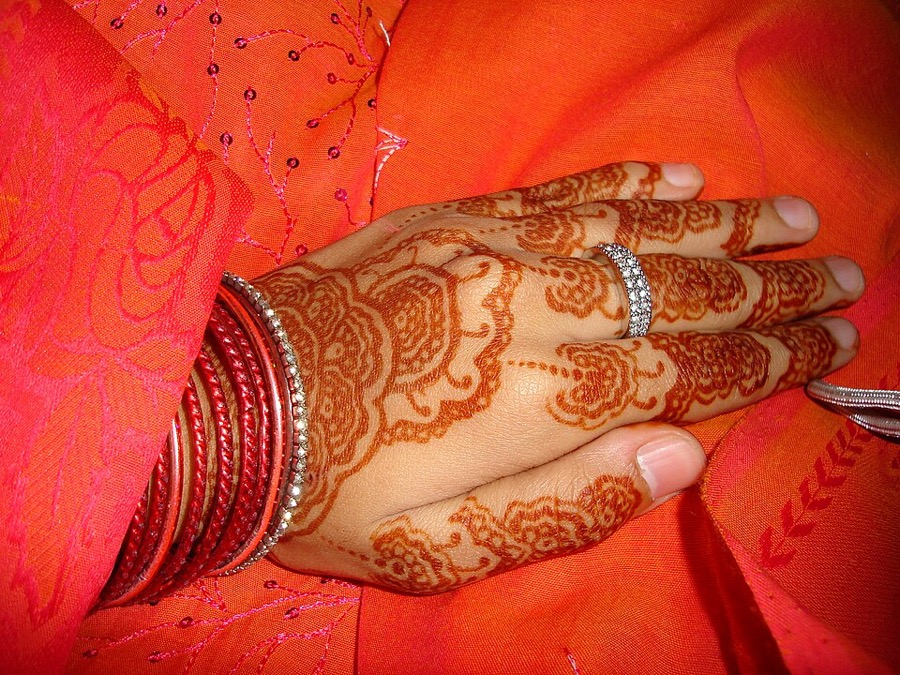
On skin, the bond forms in the outer layer and darkens as it oxidizes. The result is a family of orange, red-brown and deep brown shades. Someone searching "red henna" for a tattoo is usually hoping for the reddish end of that range, or has seen a bright red cone for sale and wants to know if it is the same thing. It is not.
On hair, lawsone colors each strand, and the result reads as red because hair is lighter than skin and catches the light. "Red henna" on a hair-dye box usually means pure henna powder, sold to make the red that henna makes naturally. The henna hair dye hub covers how that works in full.
A third meaning shows up in shops: cones and kits sold in red, pink, blue, green or glitter, still labeled "henna". Those are the products this page is most cautious about, for reasons the FDA explains below.
The red natural henna makes on skin, hour by hour
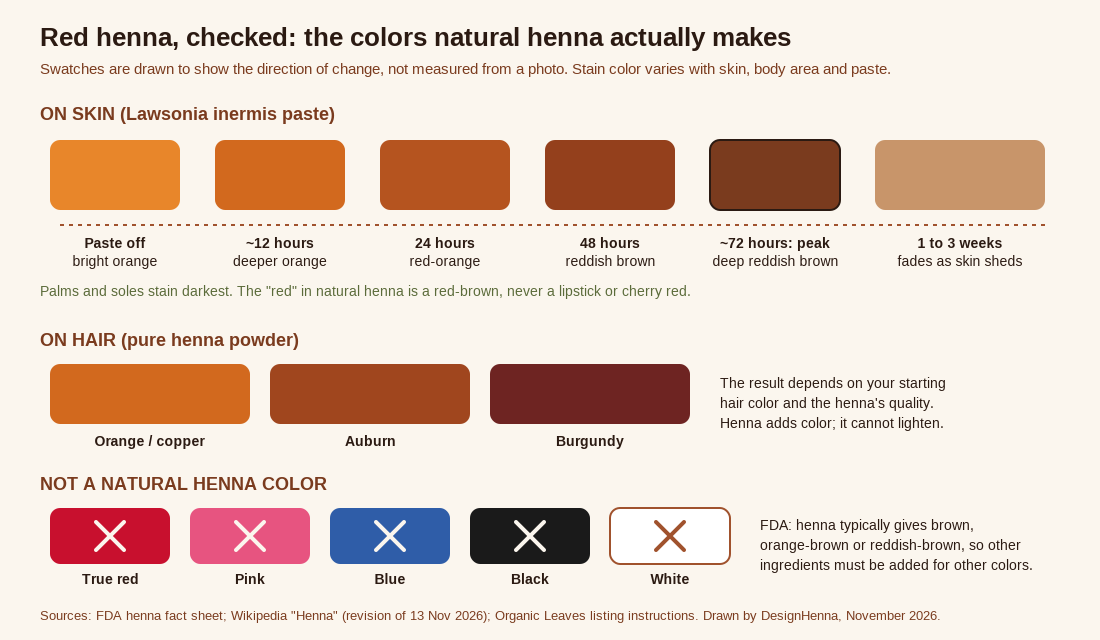
Natural henna is never at its final color when you take the paste off. Wikipedia's henna article describes the stain as orange at removal, darkening over the following three days to a deep reddish brown through oxidation. Organic Leaves' listing instructions put it at one to two days, from orange to a rich brown. Both describe the same direction of change: orange first, then redder and browner.
The chart below draws that sequence as color swatches. The intermediate swatches are our illustration of the direction, not a measurement. Real results vary with skin, the part of the body and the paste.
Three details explain most of the "is mine red enough?" questions:
- Location changes the color. The same article notes that palms and soles have the thickest skin, take up the most lawsone and give the darkest, longest-lasting stains. A design on the forearm will stay lighter and more orange than one on the palm, from the same cone.
- The peak is short. After the stain reaches its deepest color it holds for a few days, then fades as the skin sheds, typically within one to three weeks.
- It is one color family. Wikipedia puts it plainly: henna stains skin one color, a variation of reddish brown. There is no natural henna that turns skin cherry red, pink or blue.
Red, pink and other colored "henna" cones
The clearest statement about colored henna comes from the US regulator itself. In its fact sheet on temporary tattoos and henna, the FDA writes:
"Because henna typically produces a brown, orange-brown, or reddish-brown tint, other ingredients must be added to produce other colors, such as those marketed as 'black henna' and 'blue henna.' Even brown shades of products marketed as henna may contain other ingredients intended to make them darker or make the stain last longer on the skin." — FDA, Temporary Tattoos, Henna/Mehndi, and "Black Henna": Fact Sheet
Red and pink are not named in that passage, but the logic covers them: a bright red or pink is outside the brown, orange-brown and reddish-brown range, so something other than henna is making the color. The fact sheet does not say what that something is, and neither will we, because it differs from product to product. What it does say is what the law requires of it. All color additives used in cosmetics must be approved by the FDA for their intended use, with an exception only for coal-tar colors in hair dyes. Cosmetics that break those color rules count as adulterated.
Two further points from the same FDA page shape how we treat these products:
- Henna on skin is itself outside its approval. The FDA approves henna only as a hair dye, and the federal rule, 21 CFR 73.2190, permits it for coloring hair only. Body-art henna is sold as "body art quality", never as approved for skin.
- The FDA has received reports of skin injuries from products marketed as henna as well as "black henna". Black henna is the best-known case: the darkening agent is often a coal-tar hair dye containing PPD, which the FDA says can cause dangerous skin reactions in some people and is not permitted in cosmetics applied to skin. Our black henna page covers how to spot it.
That is why this site does not recommend multi-color cone kits, or kits that bundle a red or black cone with brown ones. If you want a color natural henna cannot make, choose a product designed for that color and labeled as what it is: jagua for blue-black, cosmetic body paint for white, and face-and-body paint for bright red or pink.
Natural henna, jagua, colored cones and white paint compared
Each of the four products sold near the word "henna" works differently. The table sets out what makes the color, how long it lasts and what the sources say about safety.
| Product | Colors it gives | What makes the color | How long it lasts | Safety status | Source |
|---|---|---|---|---|---|
| Natural henna (Lawsonia inermis) | Orange, darkening to reddish brown on skin; orange, auburn or burgundy on hair | Lawsone from the leaf, bonding to keratin | Skin stain fades as the skin sheds, typically within 1 to 3 weeks | FDA-approved as a hair dye only; not approved for direct application to skin | FDA fact sheet; 21 CFR 73.2190; Wikipedia "Henna" |
| Jagua (Genipa americana) | Blue-black | Genipin from the unripe fruit, reacting with the skin | Typically 1 to 2 weeks, per manufacturer instructions | Not henna; patch test first, as with any skin product | Manufacturer instructions; our jagua hub |
| Colored "henna" cones (red, pink, blue, glitter) | Whatever the added colorant gives | Ingredients other than henna, per the FDA | Depends on the product; read its label | Every color additive must be approved for its use; we do not recommend these kits | FDA fact sheet; FDA color additive summary |
| "White henna" | White | Cosmetic body paint or skin-safe adhesive with white pigment | Days rather than weeks: it sits on top of the skin | Colorants should be on the FDA's permitted list for cosmetics | FDA color additive summary; our white henna page |
Only one of the four contains henna, and it is the one that cannot be bright red.
Red hair from henna
This is the meaning of "red henna" that holds up. Pure henna powder on hair gives a genuine red, and that is what most "red henna" hair products sell. Wikipedia's henna article notes that the result depends on the hair's original color and on the henna's quality, ranging from orange to auburn to burgundy. Henna adds color; it cannot lighten. So:
- Light or gray hair shows the most of henna's own orange-red, because there is little underneath to mix with.
- Medium hair blends henna's red with its own shade, toward the auburn middle of the range.
- Dark brown or black hair gets a red tint over the existing shade rather than a new color, since henna cannot lift it lighter.
These are general patterns, not promises; strand-test hair from your brush before the full application.
The words on the pack tell you less than the ingredient list. A plant-only red lists Lawsonia inermis and nothing else. "Natural red" blends and "henna creams" can contain other plants or conventional dyes, which is fine if that is what you want, but it is a different product. Our henna dye hair colors chart shows which blend makes each shade, from orange and copper through burgundy to black, and the best henna hair dye page explains how we pick within each category.
For red hair: pure henna powder, Lawsonia inermis only

100 Grams - 100% Pure Henna Powder For Hair Dye - Red Henna Hair Color, Best Red Henna For Hair - The Henna Guys
$7.97
as of Nov 24, 2026


MB Herbals 100% Pure & Natural Henna Powder 8 oz / 227 Grams For Hair Color | For Natural Orange-Red Hair Color | Triple Sifted | No Preservatives
$9.99
as of Nov 24, 2026
Affiliate links. Product prices and availability are accurate as of Nov 24, 2026 and are subject to change. Disclosure at the end of the page.
Both powders above are sold as 100% pure henna for a red result: The Henna Guys calls its powder "Red Henna Hair Color", and MB Herbals describes its result as orange-red. Neither is a body-art product. Hair-dye henna is milled for hair and is not the paste to put in a cone for skin. The FDA fact sheet also reminds us why hair dyes carry a patch-test caution, so do one before the first full application.
One limit matters here. The federal rule permits henna for coloring hair only, and specifically not for eyelashes, eyebrows or the area around the eyes. A red henna for brows is outside that rule, and we do not cover one.
How to tell what is in a "red henna" product
You cannot judge a cone by the color of its picture. Use the label, and use the stain's behavior.
Read the ingredient list. The FDA says cosmetics sold at retail must list their ingredients on the label, and a product without one is misbranded. A natural body-art cone lists henna leaf and a short list of liquids and oils. If a product in a bright color lists only "henna", the list cannot explain the color. If it lists colorants by name, you can check each one against the FDA's summary of color additives, which shows which are permitted in cosmetics and for which uses.
Know when there is no label. The labeling requirement does not apply to cosmetic samples or to products used only by professionals, such as a booth at a fair or boardwalk, according to the same FDA page. At a stall, ask what is in the paste and decline if nobody can tell you.
Watch the color at removal. Natural henna comes off orange and darkens over days. A cone that shows bright red, pink or black the moment the paste comes off is behaving like something other than henna.
Check the shade name. A natural cone is usually sold as brown or reddish brown. Plantovika's listing title, for example, gives the shade as "Dark Reddish Brown", which matches what the plant does. A cone sold as "red" or "pink" for skin is naming a color henna does not make.
If a colored henna reacts
Stop using it, wash it off and watch the area. The American Academy of Dermatology lists the signs of a reaction to a temporary tattoo, including redness, swelling, itching, blisters and, in some cases, scarring. It also notes that a reaction can appear up to three weeks after the tattoo, so a design that looked fine on day one is not yet in the clear.
Seek medical advice for anything more than mild redness, and keep the packaging, because the ingredient list is the first thing a doctor will want to see. The FDA fact sheet also explains how to report a reaction to a temporary tattoo or other cosmetic, which helps the agency track products that cause harm.
Anyone who has reacted before, to a hair dye or a "black henna" tattoo, should skip colored cones altogether. Plain natural henna is the conservative choice, with a patch test first.
Getting the deepest natural red-brown
If you want natural henna at its reddest, the goal is to let it develop fully, not to add color. Wikipedia's henna article sets out the practical points, and they are worth checking against your own cone's instructions:
- Leave the paste on. The article says the longer paste stays on the skin, the darker and longer-lasting the stain, and suggests a minimum of four to six hours.
- Keep water off at first. It advises against removing the paste with water, because water interferes with the oxidation that develops the stain. Scrape or brush the dry paste away instead.
- Choose the right spot. Hands and feet give the deepest color, so put the design you care most about there.
- Wait two or three days before judging. The color you see on removal is the starting point, not the result.
Fresh, natural paste matters too. Pre-filled cones, like the three at the top of this page, are the simplest start, and our henna cones guide covers what to look for when you buy and store them. If you still want a black accent next to the reddish brown, use jagua, never "black henna". For the full natural kit list, go back to the henna kit hub.
Questions people ask
Is there a natural pink henna?
No. The FDA says henna typically gives a brown, orange-brown or reddish-brown tint, and that other ingredients must be added to make other colors. A pink cone is colored by something other than henna. Check its ingredient list against the FDA's list of color additives permitted in cosmetics before it touches skin.
Will red henna show on dark hair?
Henna adds color and cannot lighten, so on dark hair the result is a red tone over your existing shade rather than a bright red. How red it looks depends on your starting color and the henna's quality. Test a strand from your hairbrush first, and read the shade chart before you commit.
Why did my henna come out orange instead of red?
Because it is still developing. Natural henna is orange when the paste comes off and darkens over the next one to three days to a reddish brown. Judge the color on day two or three, not at removal. Palms and soles go darkest; thin skin on the arm stays lighter.
Sources
- FDA — Temporary Tattoos, Henna/Mehndi, and 'Black Henna': Fact Sheet; henna colors, added ingredients, PPD, ingredient labels (read November 2026)
- FDA — Summary of Color Additives for Use in the United States, cosmetics section (read November 2026)
- 21 CFR 73.2190 — Henna: permitted for coloring hair only (read November 2026)
- Wikipedia — Henna, revision 1385383905 of 13 November 2026: stain development, fade, hair shades (read November 2026)
- Wikipedia — Lawsone, revision 1380028151: the red-orange dye in henna leaves (read November 2026)
- American Academy of Dermatology — Tattoo skin reactions (read November 2026)
- Manufacturer instructions on the linked listings (Organic Leaves, Plantovika, The Henna Guys, MB Herbals) — color development and shade names (read November 2026)

Updated November 21, 2026
Sukie is the editor of DesignHenna. She researches natural henna for hair, skin and brows, compares products against manufacturer specs and live Amazon listings, and updates every guide as products and prices change.
Keep reading
- Black HennaWhy the FDA warns against it, how to spot PPD paste in five seconds, what to do after a reaction, and the safe ways to get a black design
- Henna ConesHow to tell fresh from stale, what's inside a good one, how to use and store them, and the packs to buy
- Henna Gift SetWhy most boxed sets fail the natural test, three builds that pass, and how to keep Black Friday cones fresh until Christmas
- Henna PasteWhat it is, the ratios per 100 g of powder, how to mix it, when it's ready, how to store it, and how to fix a bad batch
- Henna PowderBody-art quality vs hair grade, how to read a label, how to mix it for hair or skin, and the powders US buyers rank highest