How Long Does Henna Take to Dry? Dry to the touch, how long to leave henna on, and when the stain is finished
How long does henna take to dry? 10–45 minutes to the touch, but leave it on 2–15 hours for color. Six sources compared, plus a 48-hour timeline.

Written by Sukie
, updated November 17, 2026
General information, not medical advice. Patch-test any paste or dye first, and see a doctor if your skin reacts (signs: American Academy of Dermatology).
How long does henna take to dry? The paste dries to the touch in about 10 to 15 minutes, according to Jacquard's kit instructions, or 30 to 45 minutes before sealing, according to Henna Sooq. Dry is not the same as done, though. Leave the paste on for at least 2 to 3 hours, as the cone makers say, and up to 12 to 15 hours for the darkest stain. The color then keeps darkening for one to two days.
So there are three clocks, and most confusion comes from mixing them up. This page separates them, puts six sources side by side in one table, and draws the first 48 hours as a timeline you can plan around. How long the finished stain lasts is a different question, answered on how long does henna last. For the cones and kits themselves, start at the henna kit hub, and for how henna stains skin at all, the henna guide.
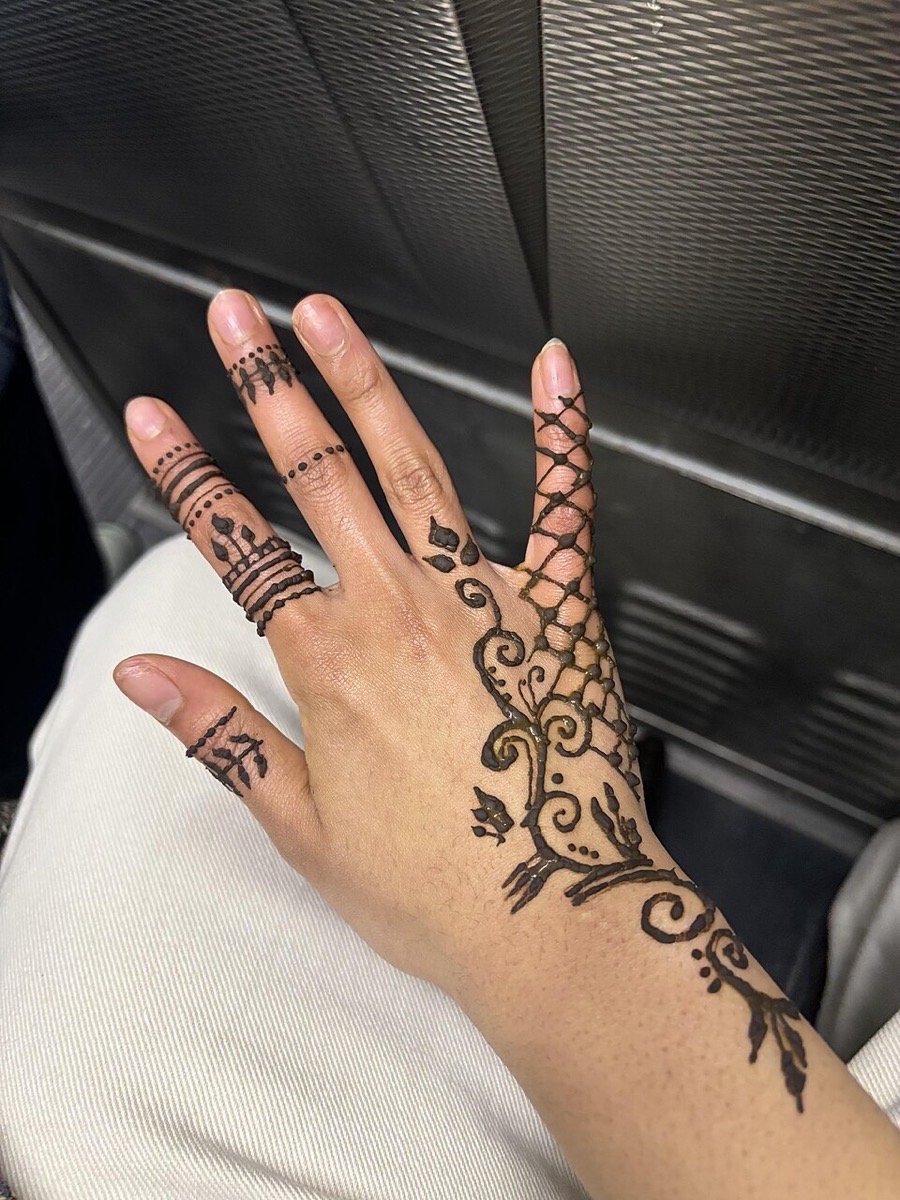
Natural pre-filled cones: dry in minutes, but plan to leave the paste on for hours
Chosen from Amazon's best-rated, best-selling listings, then checked against the ingredient list. Prices refresh daily.

Plantovika Henna Cones Made from 100% Natural Leaves | Fresh Ready-to-Use Pre-Filled Paste, Henna Tube | Dark Reddish Brown | No Additives | Long Lasting Color | Pack of 3
$9.99
as of Nov 24, 2026

Plantovika Henna Cones Made from 100% Natural Leaves | Fresh Ready-to-Use Pre-Filled Paste, Henna Tube | Dark Reddish Brown | No Additives | Long Lasting Color | Pack of 6
$8.49
as of Nov 24, 2026

Plantovika Henna Cones Made from 100% Natural Leaves | Fresh Ready-to-Use Pre-Filled Paste, Henna Tube | Dark Reddish Brown | No Additives | Long Lasting Color | Pack of 12
$12.74
as of Nov 24, 2026


Organic Leaves - Henna Cones 3 × 30 g Pack | Made from 100% Natural Henna Leaves | Ready-to-Use, Pre-Filled Cones | 5-Stage Filtered for Rich, Long-Lasting Color | Chemical-Free & Premium Quality
$7.59
as of Nov 24, 2026
Affiliate links. Product prices and availability are accurate as of Nov 24, 2026 and are subject to change. Disclosure at the end of the page.
Three different clocks: dry, left on, and fully developed
When people ask how long henna takes, they usually mean one of three things. Each one has its own answer.
Dry to the touch. This is the paste's surface losing enough water that it will not smudge. Jacquard's Mehndi Henna Kit instructions put it at 10 to 15 minutes. Henna Sooq's aftercare guide says to let the paste dry for at least 30 to 45 minutes before you seal it. Those numbers do not really disagree, because the first describes when the paste sets and the second when it is safe to dab liquid on top. In both cases, the stain has barely started.
Left on. This is how long the paste stays on your skin, and it is the number that decides how dark the result is. The sources range from an hour at the very least to 12 to 15 hours, and the table below has each one. Every source we read agrees on the direction: the longer the paste stays on, the darker the color.
Fully developed. After the paste comes off, the stain keeps changing. Plantovika's listing says the color is orange when the dried paste comes off and reaches its darkest brown in one to two days. Wikipedia's Henna article says the stain darkens over the following three days to a deep reddish brown. Judge your result on day two or three, not when you scrape the paste away.
So "it's dry, can I take it off?" has a clear answer: you can, but you would be stopping the second clock almost before it started. Drying just means you can move your hand without smudging the design.
The first 48 hours, step by step
The timeline below draws all three clocks on one axis, with the first hour stretched out so the drying step is visible. The paste-on bar shows where each source puts its minimum and best times.
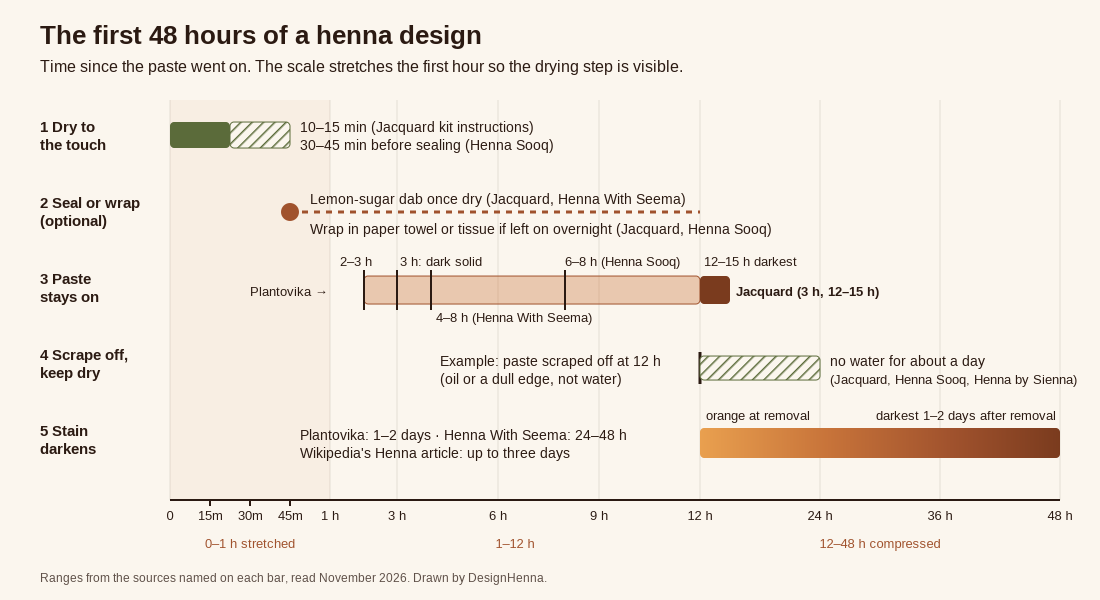
Here is the same sequence as a routine. The times come from the sources in the table in the next section.
- Start on clean skin. Jacquard says to wash the skin first, because lotion and body oil act as a barrier to the stain.
- Apply, then keep still for the first 10 to 15 minutes while the surface sets. Rest your hand on a towel rather than holding it up for the whole time.
- Seal if you want to, once the paste is dry. Dab on a lemon-sugar mix lightly with cotton. Jacquard says you can stop once the design looks black and glazy.
- Leave it on. At least 2 to 3 hours. For a deeper color, 4 to 8 hours or overnight, wrapped.
- Take it off dry. Scrape it off, or wipe it with a little oil. Do not rinse it.
- Keep the area dry for about a day. Jacquard says to avoid wetting the area for a day, and Henna by Sienna says at least 24 hours.
- Wait for the color. Orange at first, darkest about one to two days later.
How long to leave henna on skin, by source
The table compares the leave-on times six named sources publish. They are two cone and kit makers, a hair-and-henna retailer, two working artists and an encyclopedia. The ranges overlap more than they seem to: the short numbers are each source's minimum, and the long ones are for the darkest result.
| Source | Dry to the touch | Minimum time on skin | For a darker stain | After removal |
|---|---|---|---|---|
| Jacquard Mehndi Henna Kit (manufacturer) | 10–15 min | 3 h "usually results in a dark solid color" | Up to 12 h for best results; 12–15 h for the darkest, longest-lasting stain | Avoid wetting for a day; darkens overnight |
| Plantovika cones (manufacturer, Amazon listing) | "Let dry until the henna tends to flake off" | 2–3 h "for better results" | Not stated | Orange at removal, darkest brown in 1–2 days |
| Kaveri cones (manufacturer, Amazon listing) | Same wording as Plantovika | 2–3 h | Not stated | Orange at removal, darkest brown in 1–2 days |
| Henna With Seema (artist, Alpharetta, Georgia) | Not stated; let it dry naturally | 4–8 h | "Longer for deeper color" | No soap or water for 10–12 h; away from water for the first 24 h; reddish-brown over 24–48 h |
| Henna by Sienna (artist) | Not stated | "An hour at the very least"; recommends 1–2 h minimum | Overnight, wrapped | Avoid washing for at least 24 h; reddish-brown over 48 h |
| Henna Sooq (retailer's guide) | At least 30–45 min before sealing | 3–4 h | 6–8 h or overnight | Keep completely dry for at least 24 h; develops for up to 48 h |
| Wikipedia, Henna article | Not stated | 4–6 h | Not stated | Orange at removal, deep reddish brown over three days |
Two details are worth noticing. First, Plantovika and Kaveri use almost the same instruction wording on their listings, so they count as one opinion, not two. Second, Henna Sooq's own guide gives two minimums: 3 to 4 hours in its tips and 6 to 8 hours in its FAQ. We list both rather than choosing one for them.
Read across the rows and a working rule appears. Two to three hours is the floor. Four to eight hours is where most of the guidance sits, and overnight is what you do when you want the deepest color the paste can give. The paste itself matters too. Old paste stains weakly however long you leave it on, which is why the henna paste guide spends so much time on dye release and freezing, and why henna cones should arrive fresh or frozen.

Why some designs dry faster than others
None of our sources gives a drying time for each condition, so treat this section as reasoning rather than measurement. Paste dries as its water evaporates, so anything that changes how much water is there, or how fast it leaves, moves the clock.
- Line thickness. A fine line holds little paste and sets fast. A thick fill or a heavy dot holds more and stays soft inside after the edges look dry. Test the thickest part, not the edge.
- The paste recipe. Sugar is in a body-art paste to keep it sticky and moist on the skin. That is good for the stain, but it also means the paste does not dry rock-hard as quickly. Ready-made cones vary in how much they contain, and most listings do not say.
- Air and warmth. A warm, dry room or a breeze speeds up the surface. A cool, humid room slows it down.
- Too much sealant. Jacquard warns not to oversaturate the design with the citrus-sugar solution, because it dilutes and spreads the henna and fine lines thicken. A wet dab undoes the drying you just waited for.
There is one shortcut not to take. A product that dries and stains black fast is not a faster natural henna. Natural henna stains orange to reddish-brown. The FDA warns that "black henna" can contain PPD, which is not permitted in cosmetics applied to skin and can cause dangerous skin reactions. The black henna page explains how to spot it.
Sealing and wrapping: what they do and when
Once the paste is dry, it starts to crack and flake. The two aftercare tricks both exist to keep it on your skin longer.
Lemon-sugar seal. Jacquard's kit includes a citrus-and-sugar powder for this. You dissolve it in water and moisten the dry design lightly with a cotton ball, which the instructions say sets the henna "for a long lasting and darker color." Henna With Seema gives the same advice: once dry, seal with a light sugar-and-lemon dab to help the paste stick longer. Timing matters here. Seal too early and you smear wet paste. Seal too heavily and Jacquard's warning above applies.
Wrapping. This is for overnight wear. Jacquard says to wrap the area with a paper towel and tape before bed to protect the design and your bedding. Henna Sooq suggests tissue and plastic wrap to trap body heat. Henna by Sienna also suggests wrapping overnight, mostly to avoid crumbs in the bed.
Neither step is required. A design left on for three hours with no seal will still stain. Both steps make the long leave-on times practical, because without them dry paste tends to flake off before the hours are up.
An illustrative evening schedule. Say you want a design for a party on Saturday afternoon and you can apply it on Thursday evening. Apply at 7:00 pm. The surface is dry by about 7:15 pm on Jacquard's timing, or by 7:45 pm if you follow Henna Sooq's 30 to 45 minutes. Seal it, then wrap at bedtime. Scrape it off at 7:00 am Friday, which is 12 hours on, the low end of Jacquard's darkest window. Keep it dry until about 7:00 am Saturday (24 hours). On the one-to-two-day development the cone makers give, the stain is close to its darkest by Saturday. Apply on Friday evening instead and the design may still look orange-brown at the party. That schedule is our example, built from the source ranges above.
Taking the paste off, and the first day after
Taking the paste off is easy. Removing the stain is a different job, covered on how to remove henna. For the paste, the sources agree on one thing: keep water away from it.
- Jacquard says to remove the henna with a cotton ball and vegetable oil.
- Henna With Seema says to scrape the paste off gently with your fingers or a card, ideally with a little oil such as mustard, coconut or olive, and not to wash with water right after removal.
- Henna by Sienna says to rub it off over a trash can, using a little oil for the stubborn bits, and not to wash it off.
After that, the sources ask for a dry day. Jacquard says to avoid wetting the area for a day. Henna by Sienna and Henna Sooq both say at least 24 hours, and Henna With Seema says no soap and water for 10 to 12 hours and keeping the area away from water for the first 24. In practice, that means gloves for the dishes, or doing the design after your shower rather than before.
If the area turns red, itchy, swollen or blistered at any point, stop and get it looked at. The American Academy of Dermatology lists those signs for reactions to temporary tattoos and notes that they can appear up to three weeks later. For how long the stain then lasts, and how to make it last longer, see how long does henna last.
Henna on hair: a separate clock
Hair henna is a different process with its own timing, and skin drying times do not apply to it. The paste is rinsed out of the hair rather than scraped off. The Henna Guys' pure henna instructions say to let it sit on the hair for 3 hours, adding that the longer you leave it on, the better the color will be. They also say not to shampoo for 48 hours, and recommend waiting three days to see the final color. If hair is what you are coloring, the henna hair dye guide covers mixing, wrapping and two-step blends in full.
Questions people ask
How long does henna take to dry on skin?
Jacquard's kit instructions give 10 to 15 minutes. Henna Sooq says to let the paste dry for at least 30 to 45 minutes before sealing it. Fine lines reach that point sooner than thick ones, so test the thickest part of the design, gently, before you let anything touch it.
How long should you leave henna on?
At least two to three hours, as the Plantovika and Kaveri cone instructions say, and longer for a darker stain. Henna With Seema, an artist in Georgia, says four to eight hours. Jacquard says up to 12 hours for the best results and 12 to 15 hours for the darkest, longest-lasting stain.
Can I leave henna on overnight?
Yes, and several of the sources we read suggest it. Jacquard says to wrap the area in a paper towel and tape before you go to bed, so the paste does not stain your bedding. Henna by Sienna and Henna Sooq also suggest overnight wear for a deeper color.
Is one hour long enough to leave henna on?
It will leave a mark, but it is the bare minimum. Henna by Sienna calls an hour the very least and recommends an hour or two at minimum. The cone makers we read say two to three hours, so treat one hour as the option when you have no other choice.
Can I wash henna paste off with water?
It is better not to. Jacquard says to remove the paste with a cotton ball and vegetable oil and to avoid wetting the area for a day. Henna With Seema says not to wash with water right after removing the paste. Scrape or rub it off dry instead.
Why is my henna orange right after I take the paste off?
That is normal. Plantovika's instructions say the color is orange when the dried paste comes off and develops to its darkest brown in one to two days. Judge the result on day two, not in the first hour.
Sources
- Jacquard Products — Mehndi Henna Kit Instructions (EN, dated 02.02.21): drying, sealing, leave-on and aftercare times (read November 2026)
- Plantovika henna cones, Amazon listing — manufacturer's application instructions (read November 2026)
- Kaveri henna cones, Amazon listing — manufacturer's application instructions (read November 2026)
- Henna With Seema (Alpharetta, Georgia) — henna aftercare (read November 2026)
- Henna by Sienna — henna care (read November 2026)
- Henna Sooq, Khadija Dawn Carryl — henna tattoo aftercare tips (read November 2026)
- Wikipedia — Henna: application to skin and color development (read November 2026)
- The Henna Guys — pure henna hair dye application instructions (read November 2026)
- FDA — Temporary Tattoos, Henna/Mehndi, and 'Black Henna': PPD not permitted in cosmetics applied to skin (read October 2026)
- American Academy of Dermatology — Tattoo skin reactions (read October 2026)

Updated November 17, 2026
Sukie is the editor of DesignHenna. She researches natural henna for hair, skin and brows, compares products against manufacturer specs and live Amazon listings, and updates every guide as products and prices change.
Keep reading
- Black HennaWhy the FDA warns against it, how to spot PPD paste in five seconds, what to do after a reaction, and the safe ways to get a black design
- Henna ConesHow to tell fresh from stale, what's inside a good one, how to use and store them, and the packs to buy
- Henna Gift SetWhy most boxed sets fail the natural test, three builds that pass, and how to keep Black Friday cones fresh until Christmas
- Henna PasteWhat it is, the ratios per 100 g of powder, how to mix it, when it's ready, how to store it, and how to fix a bad batch
- Henna PowderBody-art quality vs hair grade, how to read a label, how to mix it for hair or skin, and the powders US buyers rank highest