How to make henna darker: the four things that control the stain, an aftercare routine, and which popular tips are myths or unsafe
How to make henna darker: fresh paste, hours on the skin, the right body area and a dry first day. Aftercare steps, plus which tips are myths or unsafe.

Written by Sukie
, updated November 19, 2026
General information, not medical advice. Patch-test any paste or dye first, and see a doctor if your skin reacts (signs: American Academy of Dermatology).
If you want to know how to make henna darker, it comes down to four things: fresh paste that still has its dye, as many hours on the skin as you can manage (overnight is common), the right part of the body, and keeping water off the design while it darkens over the next three days. Palms and soles stain darkest because their outer skin is thickest.
Everything else people try is either a way of keeping the paste on longer or a myth, and a few are unsafe. This page explains each factor with its source, gives an aftercare routine you can follow step by step, and sorts the popular tips into what the evidence supports and what it doesn't. Fresh cones are on the henna kit hub, the stain itself is explained on the henna guide, and how long a dark stain then lasts is on how long does henna last.
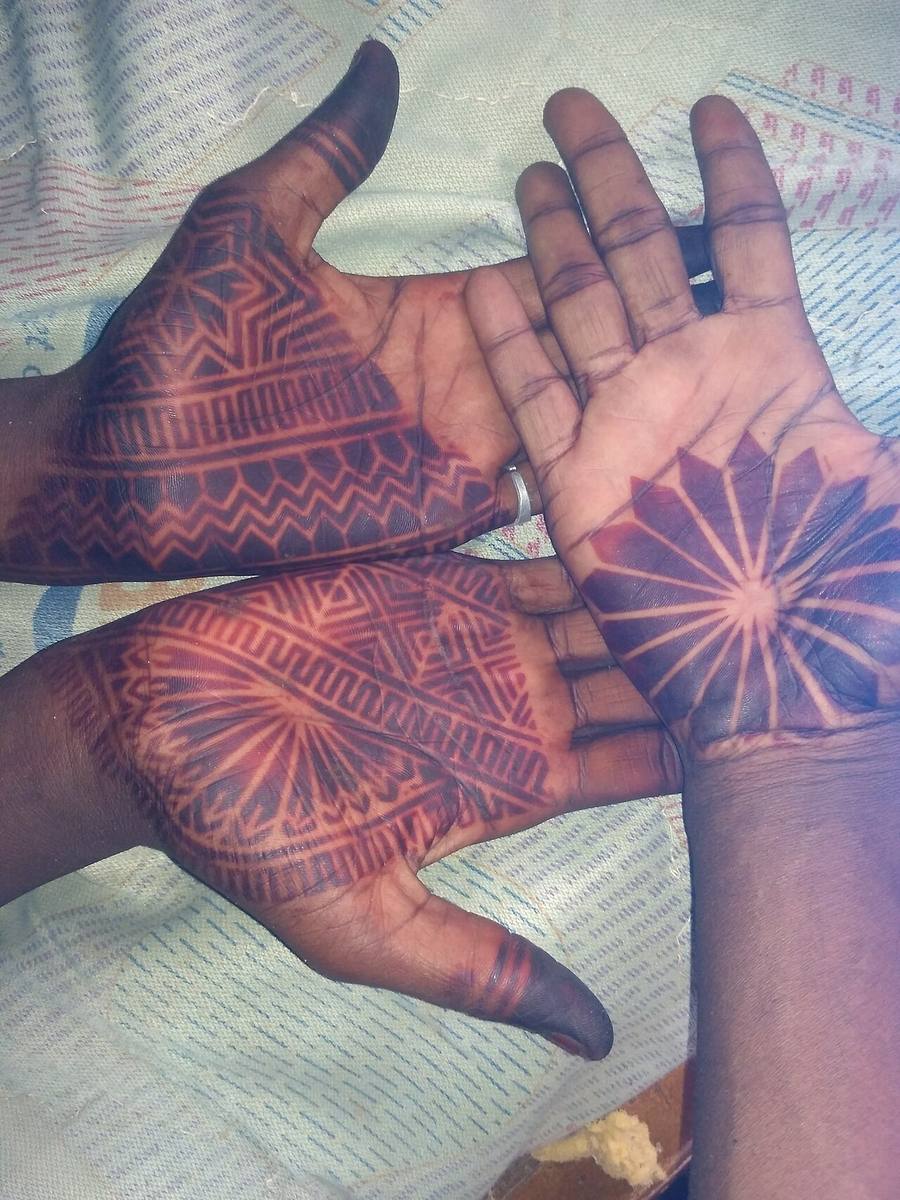
Fresh natural cones, where a dark stain starts
Chosen from Amazon's best-rated, best-selling listings, then checked against the ingredient list. Prices refresh daily.

Plantovika Henna Cones Made from 100% Natural Leaves | Fresh Ready-to-Use Pre-Filled Paste, Henna Tube | Dark Reddish Brown | No Additives | Long Lasting Color | Pack of 6
$8.49
as of Nov 24, 2026

Plantovika Henna Cones Made from 100% Natural Leaves | Fresh Ready-to-Use Pre-Filled Paste, Henna Tube | Dark Reddish Brown | No Additives | Long Lasting Color | Pack of 3
$9.99
as of Nov 24, 2026

Plantovika Henna Cones Made from 100% Natural Leaves | Fresh Ready-to-Use Pre-Filled Paste, Henna Tube | Dark Reddish Brown | No Additives | Long Lasting Color | Pack of 12
$12.74
as of Nov 24, 2026


Organic Leaves - Henna Cones 3 × 30 g Pack | Made from 100% Natural Henna Leaves | Ready-to-Use, Pre-Filled Cones | 5-Stage Filtered for Rich, Long-Lasting Color | Chemical-Free & Premium Quality
$7.59
as of Nov 24, 2026
Affiliate links. Product prices and availability are accurate as of Nov 24, 2026 and are subject to change. Disclosure at the end of the page.
What actually controls how dark henna gets
Henna's dye is a molecule called lawsone. A whole leaf will not stain skin, because the lawsone is locked inside the plant. Once the leaf is dried, powdered and mixed into a paste, the lawsone slowly moves out of the paste into the outer layer of skin and binds to the proteins there. That is the stain. The Wikipedia article on henna, which cites its references for each of these points, is the clearest public summary of the process, and nearly everything that makes henna darker follows from it. More lawsone has to reach the skin, it has to stay there long enough to bind, and the color then has to finish developing undisturbed.
1. How much dye the paste still has. A leaf holds a fixed amount of lawsone. Once powder is mixed with liquid, the dye is released over roughly two to six days, and then the leaf is spent. That is why natural paste is not shelf stable: it loses its ability to stain if it sits out for more than about a week, and why it is frozen (for up to four months) when it will not be used within a few days. A cone that sat in a warm cupboard for a month has very little left to give, however long you leave it on. It is a common reason for a pale stain, and it is the one you fix before you start, by buying fresh and freezing on arrival. Our henna cones page covers what to look for on a label, and henna paste covers mixing your own from powder, including the rest time the paste needs before the dye is ready.
The same source adds a warning that matters here. A commercial paste that still stains strongly after more than seven days without refrigeration or freezing contains something other than henna. A cone marketed as "extra dark" with a long shelf life and no ingredient list fits that pattern.
2. How long the paste stays on. A light stain can appear within minutes, but the longer the paste is on the skin, the darker and longer lasting the stain. The usual minimum is four to six hours, and many people sleep in it. If you take paste off after an hour because it has dried, you get an hour's worth of dye. Drying is not the finish line; staying in contact is.
3. Where it goes on the body. Soles and palms have the thickest outer skin, so they take up the most lawsone and take it the deepest. Hands and feet therefore get the darkest and longest-lasting stains. The diagram in the next section shows how big that difference is.
4. Undisturbed development afterwards. Henna is orange when the paste first comes off and darkens over the following three days to a deep reddish brown, a change the source attributes to oxidation. Water early on interferes with that process, which is why paste is scraped off rather than washed off.
What about warmth? Some people believe that steaming or warming the design, with the paste on or after it comes off, darkens the stain. Wikipedia's summary records that belief and says it is debatable whether it adds anything. We found no controlled test either way, so we treat warmth as optional comfort, not a step that makes henna darker. Never use a heating pad, hair dryer or steam hot enough to be uncomfortable; a stain is not worth a burn.
Essential oils are the other variable. Oils high in monoterpene alcohols, such as tea tree, cajeput or lavender, improve how the paste stains, which is why a good cone smells of them. The same source says clove and eucalyptus are not used because they can irritate the skin, though it cites nothing for that line, and henna makers disagree on eucalyptus: Jacquard's Mehndi kit ships with eucalyptus oil and Henna Sooq's recipe lists it. If your skin is sensitive, stick to lavender or tea tree.
Where henna stains darkest on the body
The difference between body areas is not small. A 1999 study in the Archives of Dermatological Research counted the layers of the outer skin (the stratum corneum) at different sites in 301 people. The abstract gives these means: face 9 layers, neck 10, scalp 12, trunk 13, arms and legs 15, palms and soles 47, and the heel 86.
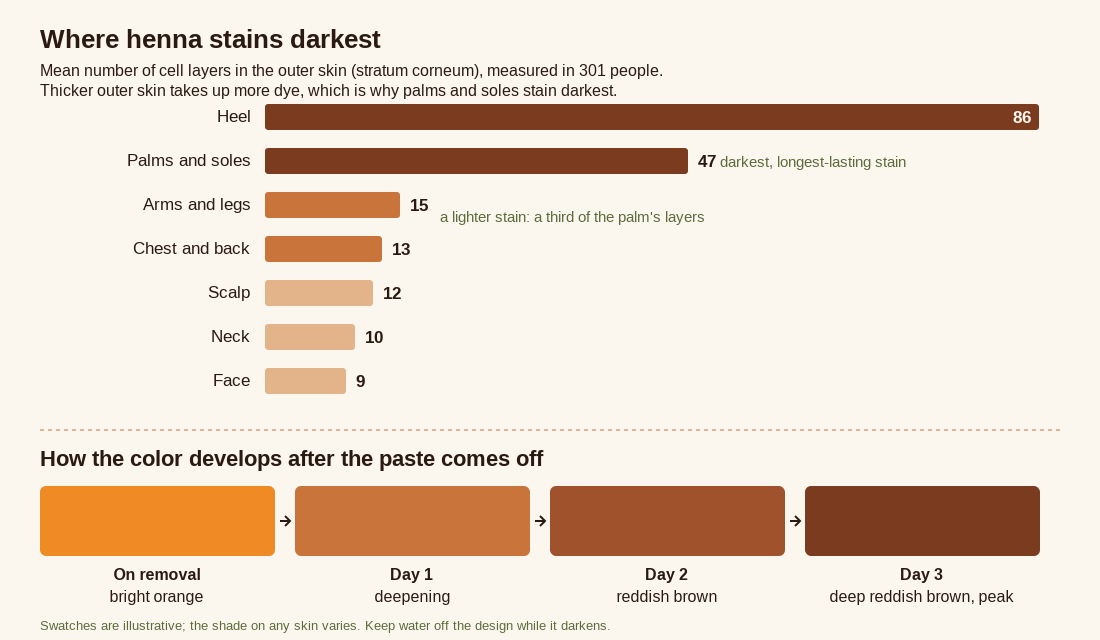
Read the chart as a guide to expectations rather than a promise. The palm has about three times the layers of the arm (47 against 15), and the heel nearly twice the palm. Wikipedia's article states the link directly only for palms and soles, but the layer counts explain the everyday pattern: the same cone that turns a palm deep brown gives a lighter, more orange stain on the forearm, and lighter still on the chest, back or neck. The differences between arms, trunk and neck are small in the data (10 to 15 layers), so on those areas the paste's freshness and the hours of wear will matter more than which of them you pick.
This is the most useful thing to know before you start, because it changes the design, not just the result:
- For the darkest possible stain, put the main design on the palm, the inner fingers or the sole. The finger henna designs page is built around the fingers.
- On the back of the hand and wrist, expect a medium brown with fresh paste. Bold lines and solid fingertip caps read darker than fine fill.
- On the arm, back or shoulder, plan for a lighter stain from the start. Thick lines and open designs suit it; delicate lacework tends to fade into the skin. Bold, open layouts work with a lighter stain rather than against it.
Henna aftercare: the routine, step by step
This routine follows from the four factors above. Each step either gets more dye in or protects the color while it develops. Times are the ones in the sources; where a step is good practice rather than a sourced rule, it says so.
- Before you start, check the paste. Use a cone that has been frozen since it was made or bought, or paste you mixed and rested yourself. Read the ingredient list. If there isn't one, or it promises black, don't use it.
- Prepare the skin. Wash the area with soap and water and let it dry fully. Skip lotion and oil beforehand; anything on the skin sits between the paste and the skin it needs to reach. (Good practice; the sources we read do not test this.)
- Patch test if it is a new product or a first time. Put a small dab on the inner arm a day ahead. The American Academy of Dermatology notes that a reaction to a temporary tattoo can appear any time up to three weeks later, so anyone who has reacted to hair dye or black henna before should skip henna altogether.
- Apply with confident, slightly thick lines. A thicker line holds more paste, and more paste means more dye at the skin. (Good practice.)
- Let it dry to the touch, then seal it. When the surface is dry, dab a mix of lemon juice and sugar lightly over the paste with a cotton ball. This keeps the paste moist and stuck to the skin, so it stays in contact longer. If your cone already contains sugar, a light dab is enough.
- Keep it on for at least four to six hours, and overnight if you can. For overnight wear, cover the dry design loosely with tissue and secure it with medical tape so the paste doesn't smear onto the sheets. Keep the wrap loose. (Good practice.)
- Remove it without water. Scrape the dry paste off with a blunt edge or rub it off with your fingers. A little cooking oil loosens stubborn flakes.
- Keep the design dry for the rest of that first day. Water interferes with the color development. If you must wash your hands, be quick and pat dry. Wear gloves for dishes. (The no-water rule is sourced; how long people keep it dry varies, and a full day is the common choice.)
- Leave it alone for three days. Don't scrub, exfoliate or swim in a chlorinated pool while the color deepens. Judge the stain on day three, not on the day you take the paste off.
- Afterwards, slow the fade. The stain leaves as the top layer of skin wears away, typically within one to three weeks. Less friction and less scrubbing keep it longer. The how long does henna last page covers the fade in detail.
A worked example, illustrative only: someone applies a palm design at 8 pm on a Thursday for an event on Sunday. With the paste on overnight and removed at 8 am on Friday, Sunday morning is day two after removal and Sunday evening is the start of day three, close to the peak. If the same person applied it on Saturday evening instead, Sunday would be day one, still on its way from orange to brown. That is why henna for an event is usually planned for two days before the photos.
Popular tips that are myths or unsafe
Search "how to make henna darker" and you will find a long list of tricks. Some are old ways of keeping paste on longer; some have no published support at all; and one category is dangerous. Here is how each holds up against the sources we could find.
Lemon-sugar: works, but as a seal, not a darkener. Wikipedia's article describes lemon-sugar as a way to stop paste drying out or falling off. That keeps the dye in contact longer, which does give a darker result. It does not add dye. A paste left on for eight hours unsealed but undisturbed would do the same job.
Heat and steam: debatable. As above, the belief exists, and whether it adds color is unproven. If you want to sit somewhere warm with a cup of tea while the paste is on, that is harmless. Steaming hands over a pan of boiling water is a risk with no proven reward.
Clove smoke and clove oil: no support found. Holding hennaed hands over smoking cloves is a folk tip passed around online. We found no published test of it. Clove oil, separately, is one of the oils Wikipedia's article says is not used in henna paste because it can irritate the skin. We would not add cloves in any form.
Vicks VapoRub: no support found, and not made for this. Vicks is an over-the-counter drug. Its label on DailyMed lists camphor 4.7%, eucalyptus oil 1.2% and menthol 2.6%, describes uses on the chest, throat, muscles and joints, and says not to use it with tight bandages. Nothing on the label relates to henna, and we found no test showing it darkens a stain. Rubbing a medicated product into freshly stained skin, and then wrapping it, is not something we would recommend.
Mustard oil, coconut oil, balms: helps the paste, not the dye. Oil applied after the paste comes off can make removal easier (the source mentions cooking oil for that). Claims that a particular oil turns a stain darker have no published test that we found.
Anything that promises black: unsafe. This is the one that matters. Natural henna only stains in one color family, a variation of reddish brown. Anything that turns skin black, or dark brown within an hour, has something else in it. The US Food and Drug Administration is direct about this:
"The extra ingredient used to blacken henna is often a coal-tar hair dye containing p-phenylenediamine (PPD), an ingredient that can cause dangerous skin reactions in some people." The FDA adds that, by law, PPD is not permitted in cosmetics intended to be applied to the skin, and that even brown shades of products marketed as henna may contain other ingredients intended to make them darker or make the stain last longer.
That last sentence is the reason to be wary of any cone sold as "extra dark" or "instant." According to the FDA fact sheet, henna itself is approved only as a hair dye, not for direct application to the skin. The AAD lists the signs of a reaction to a temporary tattoo: redness and swelling, intense itch, pain, tiny bumps, scaly raised skin, blisters that may open and leak, loss of skin color, and scarring. It says to get immediate medical care for trouble breathing, a racing heart, chest tightness or dizziness alongside a reaction. Our black henna page explains how to recognize a PPD product, and if you want a true black design, henna vs jagua covers the plant-based alternative, which still needs a patch test.
Never mix hair dye, "black henna" powder or anything with an unknown ingredient into body-art paste to deepen the color. The color you get from fresh henna, worn long on the right skin, is the color henna makes.
Why your stain came out light, and what to change next time
If a design disappointed you, work backward through the four factors. One of them nearly always explains it.
It was orange and stayed orange. Check the timing first: orange on the day of removal is normal, and the stain needs about three days to reach its peak. If it was still orange on day three, the paste was probably weak. Old cones are a frequent culprit. Next time, buy fresh, freeze on arrival and thaw one cone at a time.
It was faint everywhere. Too little time on the skin is the other likely cause. Paste that flaked off after an hour, or was wiped off once it felt dry, didn't have long enough. Seal it and keep it on for at least four to six hours.
The palm was dark but the arm was pale. That is the skin, not a failure. The layer counts above show why. Move the darkest-wanted part of the design to the hand or foot, or accept a lighter tone on the arm and draw bolder lines there.
The fingertips were darkest and faded first. Fingertips take a dark stain and then get washed constantly. That is expected. Gloves for washing up keep them longer.
It went patchy after a day. Water or scrubbing in the first day usually does this, as can a chlorinated pool or a hot bath. Keep the design dry and unscrubbed for the first day, and gentle for the three days the color is developing.
It turned black. Henna stains only in the reddish-brown range, so a black or near-black stain is not henna behaving well. Stop using that product, watch the skin for the reaction signs listed above, and see a doctor if any appear.
When you are ready to try again, start with the paste. The cones above are natural, brown-only and sold in small packs so you can keep most of them frozen. If you would rather mix your own, henna paste has the recipe, and the henna kit hub compares what else is on the market.
Questions people ask
How do you make henna darker after you take it off?
Mostly you wait and keep it dry. The stain is orange when the paste comes off and deepens over about three days on its own. Keep water away for the first day, avoid scrubbing, and do not reach for heat or chemicals. Nothing you put on afterwards adds dye that is not already in the skin.
How can you make henna darker without lemon and sugar?
Lemon-sugar is only a seal that keeps the paste stuck down and moist, so any way of keeping the paste on longer does the same job. A paste that already contains sugar, a loose wrap of tissue over the dry design, and simply staying still all help. Time on the skin matters far more than the seal.
Does Vicks make henna darker?
We found no published test that shows it does. Vicks VapoRub is an over-the-counter chest rub whose label lists camphor, eucalyptus oil and menthol, gives chest, throat and muscle uses, and warns against use with tight bandages. It is not made for henna, so we would leave it out.
Why is my henna still orange?
If you only took the paste off today, that is normal: henna is orange on removal and darkens over the next three days. If it is still orange on day three, the usual causes are old paste, too little time on the skin, water too early, or a light-staining area such as the upper arm or back.
Sources
- Wikipedia — Henna, section 'Preparation and application: Body art', revision 1385383905 of 13 November 2026, with its cited references (read November 2026)
- Ya-Xian Z, Suetake T, Tagami H. Number of cell layers of the stratum corneum in normal skin. Archives of Dermatological Research, 1999 — abstract (read November 2026)
- FDA — Temporary Tattoos, Henna/Mehndi, and 'Black Henna': Fact Sheet (read November 2026)
- American Academy of Dermatology — Tattoo skin reactions: temporary tattoos (read November 2026)
- DailyMed (US National Library of Medicine) — Vicks VapoRub drug facts label (read November 2026)
- Amazon Product Advertising API — prices and availability on the product cards, refreshed daily

Updated November 19, 2026
Sukie is the editor of DesignHenna. She researches natural henna for hair, skin and brows, compares products against manufacturer specs and live Amazon listings, and updates every guide as products and prices change.
Keep reading
- Black HennaWhy the FDA warns against it, how to spot PPD paste in five seconds, what to do after a reaction, and the safe ways to get a black design
- Henna ConesHow to tell fresh from stale, what's inside a good one, how to use and store them, and the packs to buy
- Henna Gift SetWhy most boxed sets fail the natural test, three builds that pass, and how to keep Black Friday cones fresh until Christmas
- Henna PasteWhat it is, the ratios per 100 g of powder, how to mix it, when it's ready, how to store it, and how to fix a bad batch
- Henna PowderBody-art quality vs hair grade, how to read a label, how to mix it for hair or skin, and the powders US buyers rank highest