Henna Tattoo: what it is, how the stain develops, how long it lasts, whether it is safe, and how to do one at home
Henna tattoo basics: the stain turns orange, darkens over 1–3 days and fades in 1–3 weeks. Black henna, jagua and stickers compared, plus safety and cost.

Written by Sukie
, updated November 19, 2026
General information, not medical advice. Patch-test any paste or dye first, and see a doctor if your skin reacts (signs: American Academy of Dermatology).
A henna tattoo is a temporary stain, not a tattoo. Paste made from crushed henna leaf sits on the skin for several hours, then comes off to leave an orange mark. It darkens to reddish brown over one to three days and fades over one to three weeks. No needles are involved, and nothing goes under the skin.
That is the short answer. The rest of this page covers what people search for next: why the stain starts orange and how long it lasts, how real henna differs from black henna, jagua and stickers, and what to buy or ask an artist. For design ideas, go to the henna tattoo designs gallery, which holds 48 ideas by placement. Every other style is on the henna designs hub. The plant itself is covered on the henna guide.
For a first henna tattoo: natural brown cones, reusable stencils, and jagua gel if you want black
Chosen from Amazon's best-rated, best-selling listings, then checked against the ingredient list. Prices refresh daily.

Plantovika Henna Cones Made from 100% Natural Leaves | Fresh Ready-to-Use Pre-Filled Paste, Henna Tube | Dark Reddish Brown | No Additives | Long Lasting Color | Pack of 3
$9.99
as of Nov 24, 2026

Organic Leaves - Henna Cones 3 × 30 g Pack | Made from 100% Natural Henna Leaves | Ready-to-Use, Pre-Filled Cones | 5-Stage Filtered for Rich, Long-Lasting Color | Chemical-Free & Premium Quality
$7.59
as of Nov 24, 2026

Plantovika Henna Cones Made from 100% Natural Leaves | Fresh Ready-to-Use Pre-Filled Paste, Henna Tube | Dark Reddish Brown | No Additives | Long Lasting Color | Pack of 6
$8.49
as of Nov 24, 2026

Koogel 18 Sheets 97PCS Henna Tattoo Stencil Kit, Reusable Mehndi Templates | for Bridal Mehndi & Music Festivals — Indian Wedding, Bachelorette Party, Summer Body Art, Women Girls Kids
$9.99
as of Nov 24, 2026


Fresh Jagua Tattoo Ink Gel 1oz (29.5ml) ***Top Grade Professional Made in U.s.a Ready to Use! No Mixing Necessary
$16.99
as of Nov 24, 2026
Affiliate links. Product prices and availability are accurate as of Nov 24, 2026 and are subject to change. Disclosure at the end of the page.
What a henna tattoo is, and what it is not
Henna is the dried, powdered leaf of the shrub Lawsonia inermis. In South Asia, the art of decorating skin with it is called mehndi. "Henna tattoo" is the everyday American name for the same thing, because the finished design looks like ink at first glance.
The dye is a molecule called lawsone. As Wikipedia's article on henna explains with its references, a whole leaf will not stain skin, because the lawsone is locked inside it. Once the dried leaf is crushed and mixed with a liquid such as water or lemon juice, the lawsone is released. It moves from the paste into the outer layer of skin and binds to the proteins there. That is the whole mechanism, and three things follow from it:
- It is temporary. The stain lives only in the outermost layer of skin. As that layer wears away, the design goes with it. There is no such thing as a permanent henna tattoo.
- It is one color. Natural henna stains in a single family, orange that matures to reddish brown. It cannot stain blue, white or jet black.
- It needs time. A light stain can appear within minutes, but the longer the paste stays on, the darker and longer-lasting the result.
The name is also used for products that are not henna at all, and that is where most problems start. The comparison table further down sorts them out.
How the stain develops, hour by hour
A fresh henna tattoo looks like a failure to almost everyone who sees one for the first time. The color you get when the paste comes off is not the color you end up with, and the diagram below shows why.
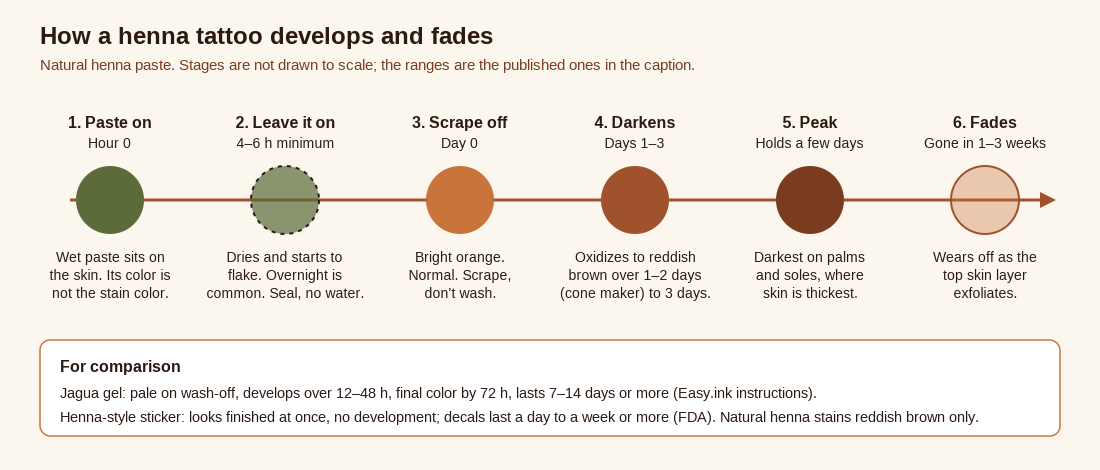
Paste on. The paste is piped from a cone or bottle onto clean, dry skin. While it is wet, it can smudge, so the first half hour is the riskiest part.
Leave it on. Wikipedia gives a minimum of four to six hours on the skin and notes that wearing the paste overnight is common. Kaveri's cone instructions say to let it dry until it starts to flake and recommend two to three hours for better results. To stop dry paste falling off early, artists often dab a sugar and lemon mix over it.
Scrape off. Brush or scrape the dry paste away instead of washing it off. Wikipedia notes that water interferes with how the stain develops, and that a little cooking oil can loosen stubborn paste. The design underneath will be bright orange.
Darkens. Over the next days the stain oxidizes and deepens to reddish brown. Kaveri's instructions put the darkest point at one to two days, and Plantovika's listing says to allow 24 to 48 hours for the color to fully develop. Wikipedia describes the darkening as lasting three days.
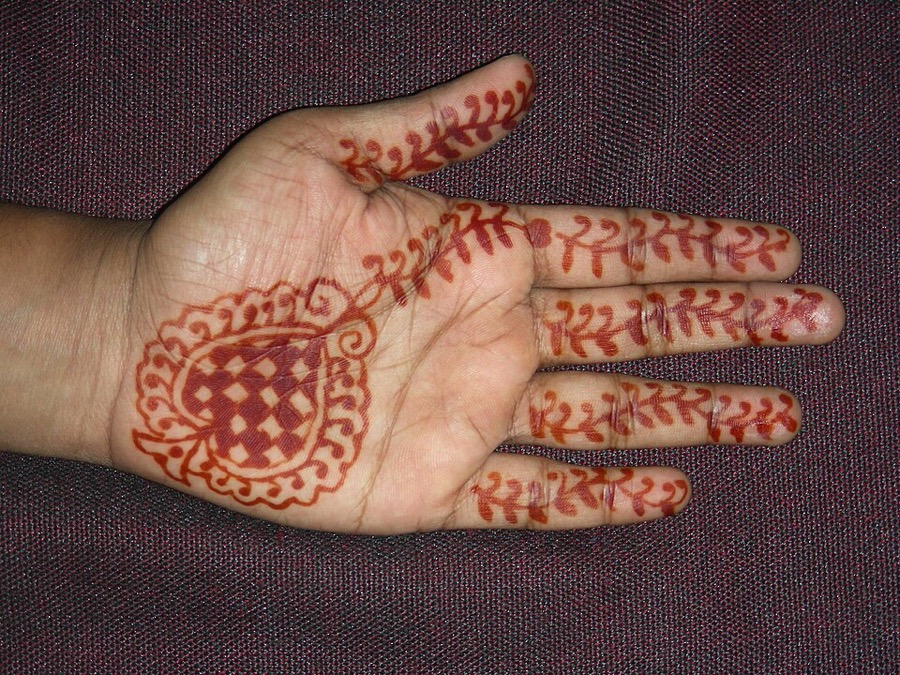
Peak. The stain holds at its darkest for a few days. Palms and soles have the thickest skin, so they take up the most dye and show the darkest, longest-lasting color.
Fades. Then it wears off gradually as the skin exfoliates, typically within one to three weeks.
How long a henna tattoo lasts
Typically one to three weeks, with the darkest color around days two and three. Where the design sits matters most, followed by how fresh the paste was and how long it stayed on.
Placement sets the ceiling. The thick skin of the palms and soles takes up the most dye, so designs there last longest. Thinner skin elsewhere takes up less dye.
Paste time is the second lever. A design scraped off after an hour gives a light stain that fades quickly, and an overnight wear gives the most.
Paste freshness is the third, and the most often overlooked. Wikipedia notes that a natural paste is not shelf stable and loses its ability to stain if left at room temperature for more than about a week. That is why good cones are kept cold.
Product claims vary. Kaveri, for example, says its color lasts up to 7 to 12 days. Treat any figure on a listing as that product's estimate, not a promise. Our how long does henna last page goes through placement and aftercare in more detail.
Henna tattoo vs black henna vs jagua vs stickers
Four different products are sold under the henna tattoo name, and they behave very differently. The table sets out what each one is, how it develops, how long it lasts, and the safety point that matters for each.
| Natural henna | "Black henna" | Jagua | Henna-style stickers | |
|---|---|---|---|---|
| What it is | Paste of crushed Lawsonia inermis leaf | Paste blackened with an added dye, often a hair dye containing PPD (FDA) | Gel made from the fruit of Genipa americana | Printed decal, a temporary tattoo transfer |
| Color on skin | Orange at first, then reddish brown | Black | Blue-black | Any color printed, including brown, white and black |
| Development | Orange on removal, darkest after 1–3 days | Not a natural henna process | Pale when washed off, develops over 12–48 hours, final color by 72 hours (Easy.ink) | None; looks finished at once |
| How long it lasts | Typically 1–3 weeks | Not worth asking | 7–14 days or more (Easy.ink); one week to a month by skin type (Fresh Jagua) | A day to a week or more (FDA, for decals) |
| Safety point | Natural, but henna is approved by the FDA only as a hair dye | PPD can cause dangerous skin reactions and is not permitted in cosmetics applied to skin (FDA) | Natural, but can still cause allergic reactions; Fresh Jagua recommends a skin test first | The FDA has received reports of reactions to some decals, and some imports contain colors not permitted on skin |
| Read more | Henna cones | Black henna | Jagua | Henna tattoo stickers |
The practical rule: a paste that stains skin black is not natural henna. For a black design, jagua is the plant-based route, and stickers are the no-commitment one.
Is a henna tattoo safe?
Natural henna has a long history as body art, but "natural" is not the same as "approved", and the risks come mostly from what else ends up in the paste. Here is what the regulator and the doctors actually say.
The FDA's position. The FDA's fact sheet says henna is approved only as a hair dye and is not approved for direct application to the skin, as in mehndi. No henna is "FDA-approved for tattoos", whatever a listing says.
Black henna. The same fact sheet explains that the ingredient used to blacken "black henna" is often a hair dye containing p-phenylenediamine (PPD). PPD can cause dangerous skin reactions in some people, and by law it is not permitted in cosmetics applied to skin. Our black henna page explains how to recognize it at a booth or on a listing.
Signs of a reaction. The American Academy of Dermatology's guide to tattoo skin reactions lists redness and swelling, intense itch, pain, tiny bumps, blisters, loss of skin color and scarring among the signs of a reaction to a temporary tattoo, and says the reaction is usually caused by a black dye. A reaction can appear any time up to three weeks after the tattoo, so a design that looked fine on day one is not yet in the clear. The AAD advises seeing a board-certified dermatologist if a mild reaction lasts longer than a week, and getting immediate medical care for trouble breathing, a racing heart, dizziness, intense swelling or hives.
After PPD. Once someone has reacted to PPD, they may react again to hair dyes and related chemicals. DermNet's clinical page covers this sensitization in detail. Anyone with a past reaction to black henna or hair dye should talk to a doctor before trying any temporary tattoo.
Children. Medical case reports, including Raupp and colleagues in 2001, link topical henna to serious reactions in children with G6PD deficiency. A 2022 review advises avoiding henna in infancy until G6PD status is known.
Patch test. For anyone else, dab a little paste on the inner arm a day or two ahead and watch the spot. Remember that some reactions take longer than that to appear.
If you have a reaction to a cosmetic product, the FDA asks consumers to report it, and its fact sheet links to the complaint page.
How to do a henna tattoo at home
A simple design at home needs natural paste, clean skin and patience. You do not need drawing skill if you use a stencil.
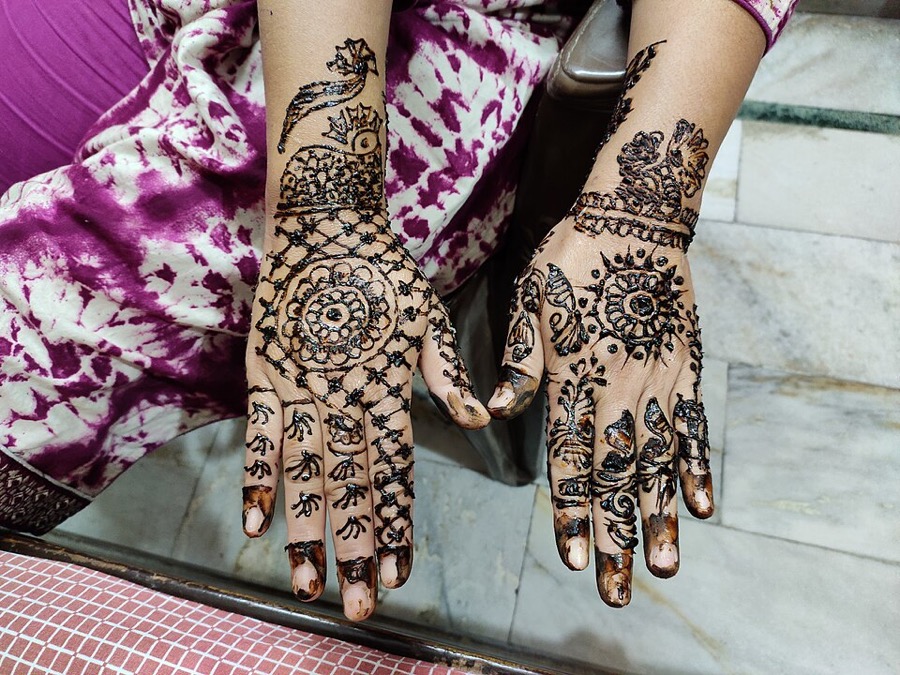

- Patch test first. A day or two ahead, put a small dab of paste on the inner arm and watch for redness or itching.
- Thaw the cone. If the cones were frozen, let one come to room temperature. Plantovika suggests about an hour.
- Prepare the skin. Wash the area with soap and water and dry it fully.
- Place a stencil or practice first. Press an adhesive stencil firmly onto the skin, or draw your design on paper with the cone to learn how hard to squeeze.
- Pipe the paste. Remove the cap or pin from the tip, trimming the tip only if the line is too thin, and squeeze gently, as the cone makers' instructions describe. Keep the line raised on the skin rather than dragging it flat, and wipe mistakes away at once with a damp cotton bud.
- Lift the stencil while the paste is wet, peeling slowly from one corner.
- Let it dry, then seal it. When the paste looks dry, dab a sugar and lemon mix over it to keep it from drying out and falling off.
- Leave it on. Aim for at least four to six hours, or overnight.
- Scrape, don't wash. Remove the dry paste with a blunt edge or your fingers. A drop of cooking oil helps with stubborn bits.
- Wait. The stain will be orange. Leave it alone and let it darken over the next one to three days.
The first day after the paste comes off
The first day is when a henna tattoo either develops properly or gets washed away. Most of the advice comes down to keeping water off the design while it is still orange, and leaving it alone while it darkens.
Water is the main thing to manage at removal. Wikipedia notes that water interferes with the oxidation that darkens the stain, so scrape the paste off rather than rinsing it, and don't rush to scrub the orange design. Steaming or warming the design is a traditional trick, though Wikipedia records that it is debated whether this darkens the stain.
After it has peaked, the stain wears off as the skin exfoliates. Anything that speeds exfoliation shortens the design's life: scrubs, long hot soaks, swimming and friction from straps and cuffs. If you would rather it went sooner, those same things are the removal method, and our how to remove henna page lists them in order.
Fresh paste: why cones go off
Paste quality decides more than technique. A perfect application with tired paste still gives a faint stain, so it is worth understanding what "fresh" means.
Henna leaf holds a finite amount of lawsone. Wikipedia notes that once powder is mixed, the dye release runs for an average of two to six days. A mixed paste has to rest between one and 48 hours before it is ready, depending on the crop. Paste that will not be used within a few days can be frozen, which Wikipedia says halts the dye release for up to four months.
That leads to the warning buyers most need. Citing its own references, Wikipedia states that commercial pastes which still stain after more than seven days without refrigeration or freezing contain other chemicals besides henna, and that these may be dangerous to the skin. We cannot test any particular cone. What you can do is prefer sellers who tell you to refrigerate or freeze their cones, read the ingredient list, and be wary of a long shelf life for mixed paste at room temperature.
Ingredients matter too. Wikipedia notes that essential oils high in monoterpene alcohols, such as tea tree, cajuput and lavender, improve the stain, and says (without a citation) that eucalyptus and clove are not used because they can irritate the skin. Henna makers disagree on eucalyptus: Jacquard's Mehndi kit ships with eucalyptus oil and Henna Sooq's recipe lists it beside the other three. Lavender or tea tree is the safer pick for sensitive skin. Check the label of any cone before you use it near a child or on sensitive skin. Our henna cones page compares what is on the market.
What to buy for a first henna tattoo
For one person, or a small group trying it for the first time, you need four things. Avoid boxed kits that add colors henna cannot make.
- Natural brown cones. A three-pack is enough for a first attempt. Look for a named ingredient list and storage instructions that tell you to keep them cold. The cards above show the cones this site lists, with prices refreshed daily.
- A stencil sheet. Reusable adhesive stencils let a beginner produce a clean design the first time, and they are the fastest way to get a finished look.
- A sealant. Sugar dissolved in lemon juice works; you probably have both already.
- Cotton buds for fixing mistakes while the paste is wet.
Skip any kit that includes black, red or multi-colored cones. Henna stains in one color family, so those cones are something else, and a black one may contain PPD. If you want a black design, buy jagua gel separately and patch test it. Our henna tattoo kit page explains how to read a kit listing line by line.
How much a henna tattoo costs
There is no standard price, and we have not found a reliable national average. The cost depends on the artist, the size and detail of the design, and the setting, such as a studio, a fair booth or a party.
Two studios publish their rates, which makes the arithmetic visible:
| Published by | Rate | Speed | Illustrative cost per simple design |
|---|---|---|---|
| Mehndi by Madiha, Alexandria, Virginia | $75 an hour, two-hour minimum | 8 to 10 guests an hour, simple designs | $75 ÷ 10 = $7.50 to $75 ÷ 8 = $9.38 |
| Simran's Mehndi, British Columbia (form dated 2025) | $100 an hour per artist, currency not stated | About 15 simple designs an hour | $100 ÷ 15 = about $6.67 |
The last column is our own sum, not a menu price. These are simple party-speed designs, and a palm-to-wrist piece or a bridal set takes far longer and costs proportionally more. Two studios are not a market average, so treat the figures as a starting point, not a budget.
When you contact an artist, ask four things: the price by size or by time, whether there is a minimum booking, whether they use natural paste they mix themselves, and what is in it. A good artist will answer the last question happily. If the answer is vague, or the booth offers black henna, walk away.
Getting a henna tattoo from an artist
Searching "henna tattoo near me" turns up salons, mehndi artists, event services and fair booths. The quality varies more than the price does, so use a short checklist before you sit down.
- Look at the paste. The artist should be happy to tell you what is in it and show you the cone.
- Ask about black. If black henna is on the menu, the FDA's warning applies. Choose an artist who offers only natural brown, or jagua clearly labelled as jagua.
- Ask how long to keep it on. An artist who says to wash it off in half an hour is either rushed or not using henna. Natural paste needs hours.
- Bring a picture. Show the size and placement you want. Our henna tattoo designs gallery is a good place to find one.
- Plan the timing. The stain peaks a day or two after application, so for an event, have it done two days before.
Removing a henna tattoo early, and where to go next
A henna stain cannot be washed off like ink, because the dye is bound into the outer layer of skin. What you can do is speed up the exfoliation that removes it anyway: warm water, a gentle sugar or salt scrub, a swim. The how to remove henna page gives the steps and the things not to put on skin.
If a stain came out faint, look at the paste's freshness and how long it stayed on before blaming the brand.
From here, the henna tattoo designs gallery has ideas by placement and motif. The henna tattoo kit guide covers buying in more depth, and jagua is the page for a black design that does not involve PPD. The henna designs hub links every design guide on the site.
Questions people ask
How long does a henna tattoo normally last?
Typically one to three weeks. The stain peaks one to three days after the paste comes off, holds for a few days, then fades as the top layer of skin wears away. Palms and soles keep it longest, because the skin there is thickest. Cone makers quote their own ranges, such as Kaveri's 7 to 12 days.
How much does a henna tattoo cost?
It depends on the artist, the size of the design and the setting, and there is no national price list. One Virginia studio publishes $75 an hour at 8 to 10 simple guest designs an hour, which works out at roughly $7.50 to $9.40 a design. Larger and more detailed work costs more, so ask the artist for a quote by size.
Is a henna tattoo permanent?
No. Natural henna stains only the outer layer of skin, and that layer wears away. A design is usually gone within one to three weeks. Anything sold as a permanent henna tattoo is not henna.
Why is my henna tattoo orange?
Because it is new. Henna is orange when the paste first comes off and darkens to reddish brown over the next one to three days as the dye oxidizes. Don't judge the color until day two or three.
Does getting a henna tattoo involve needles?
No. The paste is piped or drawn onto the surface of the skin and left there to dry. Nothing goes under the skin, which is why the result is temporary.
What is henna tattoo ink?
Natural henna is a paste of crushed leaf, not an ink. Products sold as henna tattoo ink are usually something else: jagua gel, cosmetic tattoo markers, or in the worst case a black paste that may contain PPD. Read the ingredient list before you buy.
Can kids get a henna tattoo?
Older children can have a small natural design after a patch test. Medical case reports link henna to serious reactions in children with G6PD deficiency, and a 2022 review advises avoiding it in infancy until G6PD status is known. Never use black henna on a child.
Can I get a henna tattoo if I have reacted to hair dye?
Stay away from anything sold as black henna, because PPD is a common hair-dye ingredient. DermNet notes that people sensitized to PPD can also react to related chemicals. Ask a dermatologist before trying any temporary tattoo, including natural henna.
Can I shower with a henna tattoo?
Keep water off while the paste is on and when you take it off. Scrape the dry paste away instead of washing it, because water interferes with how the stain develops. After that, washing is fine, but every scrub and long soak speeds up the fade.
Sources
- FDA — Temporary Tattoos, Henna/Mehndi, and 'Black Henna': Fact Sheet, content current as of 10/15/2024 (read November 2026)
- American Academy of Dermatology — Tattoo skin reactions (read November 2026)
- Wikipedia — Henna, revision of 13 November 2026: preparation, application and stain development, with its cited references (read November 2026)
- DermNet — Allergy to paraphenylenediamine (read November 2026)
- Raupp P et al., Archives of Disease in Childhood, 2001 — henna and G6PD deficiency (read November 2026)
- Review, 2022 — henna and G6PD deficiency in infancy (read November 2026)
- Mehndi by Madiha, Alexandria, VA — published guest rate and hourly price (read November 2026)
- Simran's Mehndi booking form, British Columbia, dated 2025 — designs per hour and hourly rate (read November 2026)
- Manufacturer instructions on Amazon listings: Kaveri henna cones (paste time, color development, wear), Plantovika (24–48 h development, fridge or freezer storage), Easy.ink and Fresh Jagua (jagua timing, wear, skin test) (read November 2026)

Updated November 19, 2026
Sukie is the editor of DesignHenna. She researches natural henna for hair, skin and brows, compares products against manufacturer specs and live Amazon listings, and updates every guide as products and prices change.
Keep reading
- Arabic Henna DesignsBold florals, flowing vines and the negative space that makes them work
- Back Henna DesignsNape to lower back, zone by zone, drawn by a friend and planned around the dress
- Back of Hand Henna Designs15 layouts, the flow rule that makes them flatter your hand, and how to draw them
- Bridal Henna DesignsStyles, the two-day timeline, what it costs in the US, and how to brief an artist
- Butterfly HennaSix drawn designs to copy, where each one sits on the body, and how to draw a butterfly in five strokes