Henna Arm Designs: a placement ladder from the wrist cuff to the full sleeve, why arms stain lighter than hands, and five sets to copy tonight
Henna arm designs by zone: wrist cuffs, inner and outer forearm, elbow, upper arm bands, shoulder caps, full sleeves, why arms stain lighter, and five sets to copy.

Written by Sukie
, updated November 14, 2026
General information, not medical advice. Patch-test any paste or dye first, and see a doctor if your skin reacts (signs: American Academy of Dermatology).
Sleeve pushed past the elbow, forearm flat on the kitchen table, cone warm from ten minutes in your palm. You set the tip at the wrist crease and pull the first line toward the elbow in one stroke — and you learn, in that one stroke, that the arm is not the hand. The skin is smoother, the line travels faster, and there is far more of it to fill than you planned for. Henna arm designs are a different job: a bigger canvas, a lighter stain, and a placement you see from angles nobody else does. This page treats the arm as a ladder — wrist cuff, inner forearm, outer forearm, elbow, upper arm band, shoulder cap, full sleeve, and the arm and hand drawn as one piece — with named designs on each rung, five complete sets to copy tonight, and a plain account of how each zone stains. Hands have their own pages, back of hand henna designs and finger henna designs; the style families live on the henna designs hub; the stain itself is explained on the henna guide.
Two rules run up the whole ladder. The stain gets lighter as you climb — medium brown at the wrist, light brown on the forearm, lighter still above the elbow — so the higher the design sits, the bolder it needs to be: thick lines, solid dots, no fine lattice. And decide who the design is for: inner-forearm work faces you; outer-forearm and upper-arm work faces everyone else. That decides which way up the motif goes.
Drawn designs to copy
Drawn by DesignHenna for this guide. Print the PNG at 100% to trace it, or copy it freehand with a cone. Times are planning estimates.
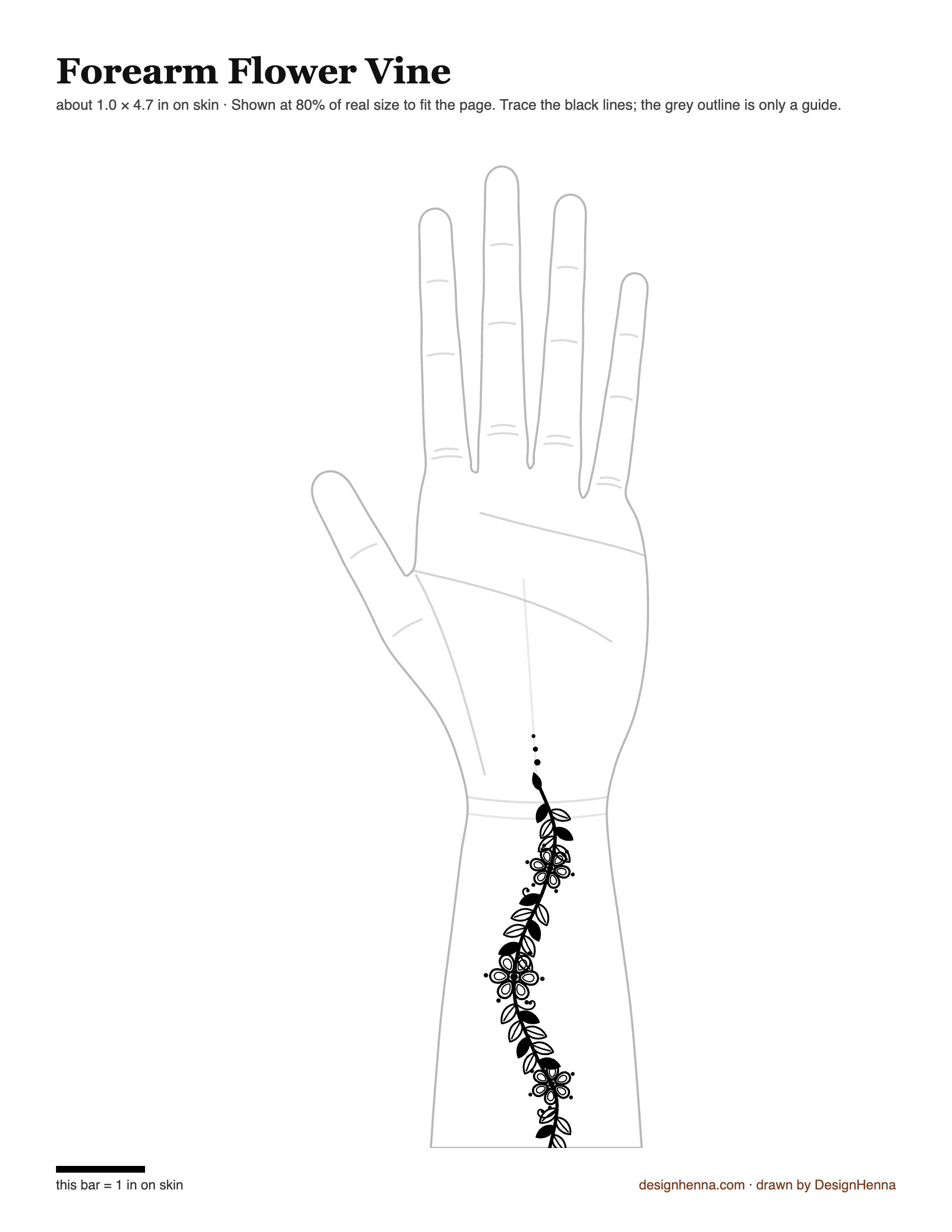
Forearm Flower Vine
Arm · Intermediate · about 20–30 min · about 1.0 × 4.7 in on skin
A single flowering vine from the wrist crease down the inner forearm, the classic vertical-vine forearm design.
- Draw the main vine first as one gentle S-curve from the wrist crease toward the elbow, keeping the line thick and even.
- Mark three flower positions on the vine, one near the wrist, one at mid-forearm and one lower down, and draw each as six round petals around a small circle and dot.
- Add a thin inner line in every petal and a dot beyond each petal tip.
- Fill the vine between the flowers with alternating leaves, solidly filling every third one.
- Finish with a curling tendril just past each flower and a filled bud with three dots at the wrist crease.
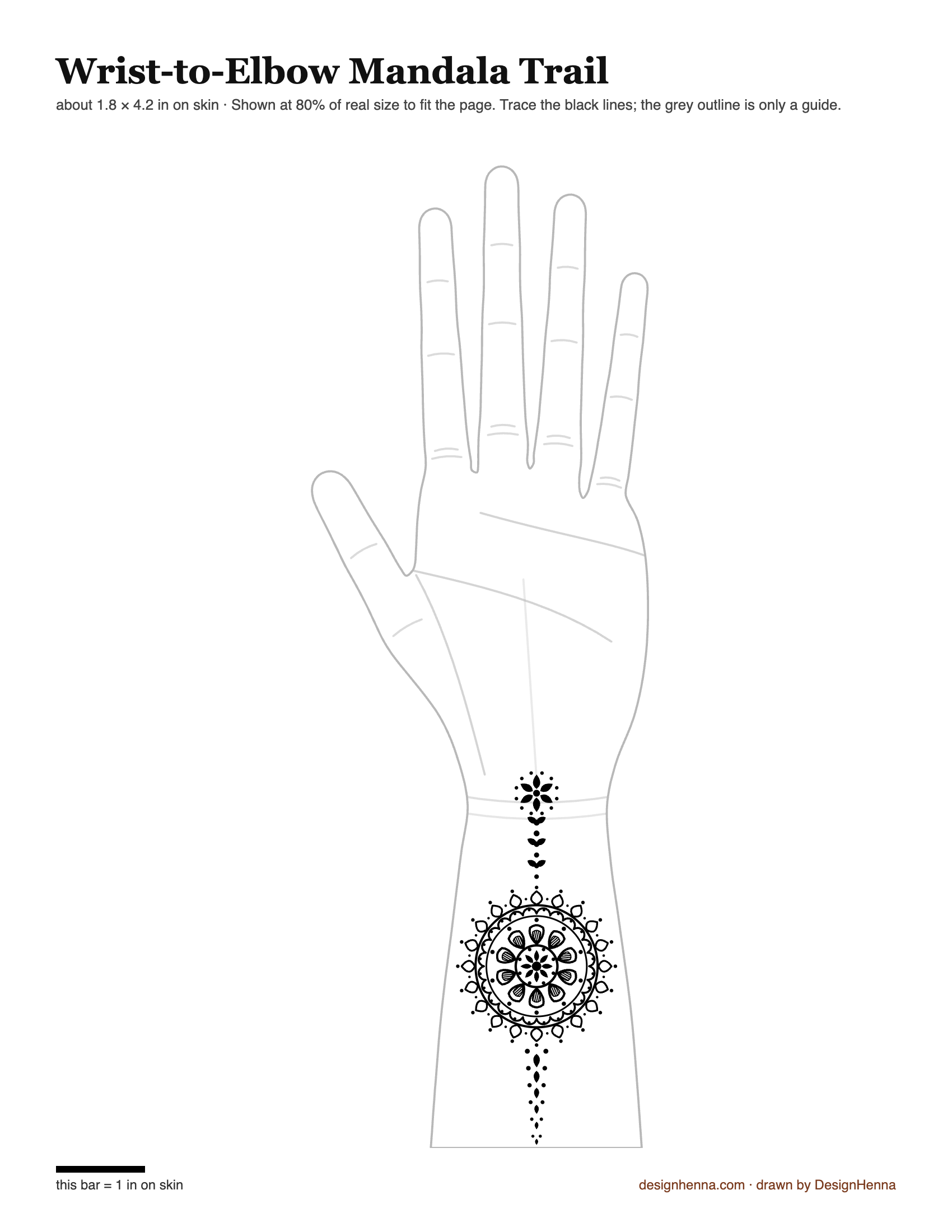
Wrist-to-Elbow Mandala Trail
Arm · Advanced · about 35–45 min · about 1.8 × 4.2 in on skin
A full mandala at mid-forearm linked to a wrist flower above and a teardrop trail below, so the design runs from wrist toward the elbow.
- Place a single dot at mid-forearm for the mandala centre and draw the inner ring of filled petals and dots around it.
- Draw a circle, then a band of ten petals with hatched inner shapes, then a dot at each petal tip.
- Add the outer circles with a scalloped ring and dots, then the ring of outlined teardrop points and the outer dot border.
- Draw the six-teardrop flower on the wrist crease and join it to the mandala with a line of dots and small paired leaves.
- Below the mandala, draw a chain of teardrops that get smaller toward the elbow, each with a dot on either side.
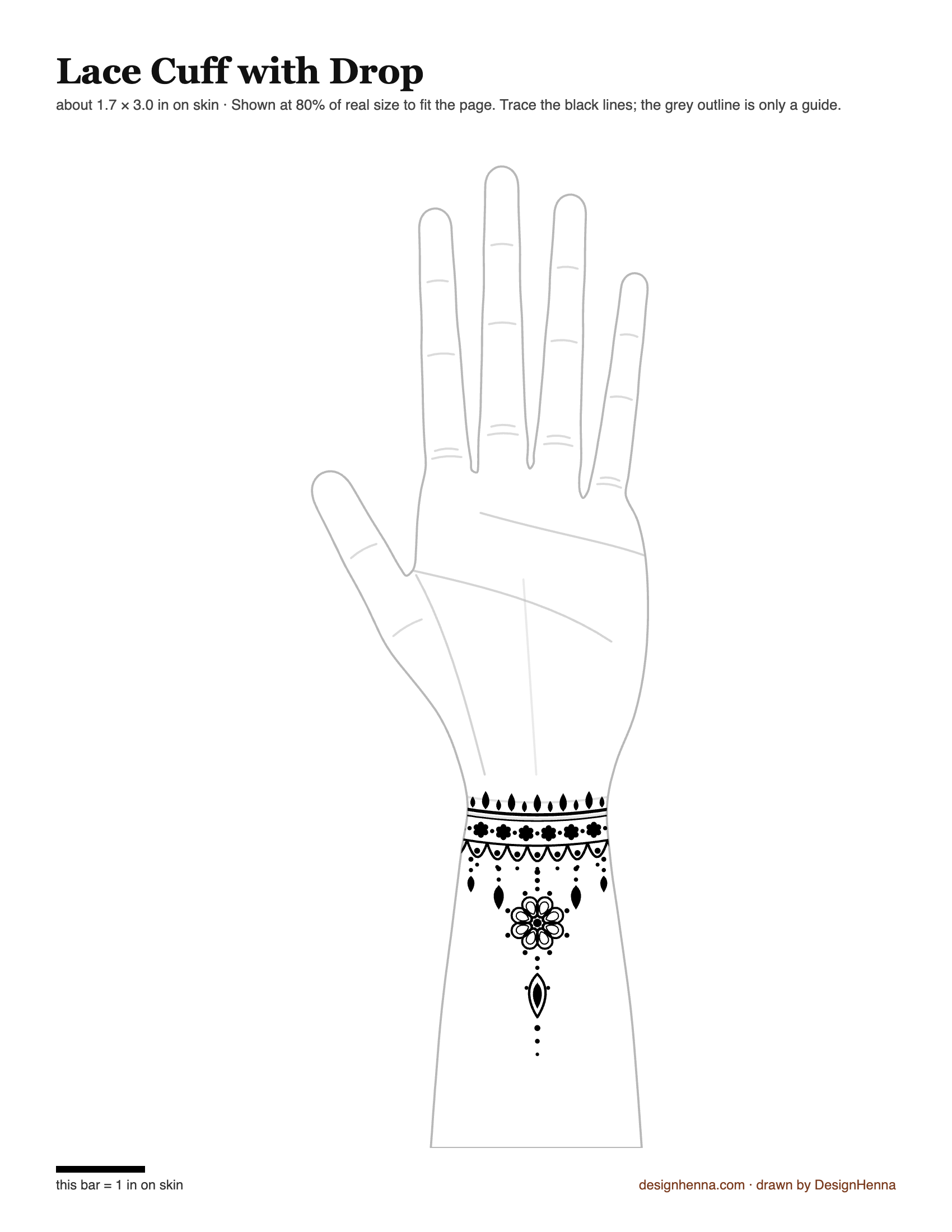
Lace Cuff with Drop
Wrist · Intermediate · about 20–25 min · about 1.7 × 3.0 in on skin
A layered lace cuff that wraps the wrist, with a jewellery-style flower and teardrop drop hanging down the forearm.
- Draw a thick line around the wrist just below the crease, following its curve, and a thin line just under it.
- Add teardrops pointing up from the top line, alternating long and short.
- Draw a second line lower down and fill the band between with small solid flowers separated by dots.
- Hang deep scallops from the lower line and put a dot in each curve.
- From the centre, draw a short dot chain, a layered eight-petal flower and an outlined teardrop with a solid one inside, then add the shorter side drops.
Cones, a flexible practice hand and arm stickers
Chosen from Amazon's best-rated, best-selling listings, then checked against the ingredient list. Prices refresh daily.

Plantovika Henna Cones Made from 100% Natural Leaves | Fresh Ready-to-Use Pre-Filled Paste, Henna Tube | Dark Reddish Brown | No Additives | Long Lasting Color | Pack of 6
$8.49
as of Nov 24, 2026

Plantovika Henna Cones Made from 100% Natural Leaves | Fresh Ready-to-Use Pre-Filled Paste, Henna Tube | Dark Reddish Brown | No Additives | Long Lasting Color | Pack of 3
$9.99
as of Nov 24, 2026

10 Sheets Brown Henna Tattoo Kit, Lace Fake Tattoos Semi Permanent Tattoo Stickers Waterproof Henna Tattoo Stickers for Women Wedding Party Festival Tattoos Decorations(Henna Tattoo) 538
$6.99
as of Nov 24, 2026

10 Sheets Black Henna Tattoo Kit, Waterproof Henna Tattoos Stickers for Women Wedding Party Festival Decorations 723
$9.99
as of Nov 24, 2026

Krofaue 2 Pack Right Hand Nail Practice Trainer, Flexible Bendable | 2 right hands, hard rubber, flexible fingers, realistic skin tone, for acrylic and gel and beginner,salon tool,reusable
$9.99
as of Nov 24, 2026
Affiliate links. Product prices and availability are accurate as of Nov 24, 2026 and are subject to change. Disclosure at the end of the page.
Wrist cuff
The wrist is where every arm design starts and where most of them should stop. It is the one rung that stains close to the back of the hand — a medium brown that holds ten to fourteen days on the how long does henna last timeline — so a cuff is the only arm placement that goes reasonably dark without heroic aftercare. It takes ten minutes and a small fraction of a cone, and it reads as jewelry, which is why it is the arm design people wear to work.
Wrap the band in two halves that meet on the underside: rest the cone tip, rotate the arm underneath it, stop at the side, come back from the other direction. Keep it a finger-width above the crease so the bend of the wrist doesn't crack it while it dries.
- Double line with drops — two parallel bands, teardrops hanging toward the hand.
- Lace cuff — a band of scallops with a dot in each curve.
- Vine bracelet — a vine circling once, leaves alternating sides, a bud at the join.
- Scalloped edge — the lower edge scalloped, the upper edge straight; simple and finished-looking.
- Inner-wrist script — a date or a single word along the crease; the inner wrist is flat enough for lettering.
Inner forearm
The inner forearm is the flattest, smoothest, palest skin on the arm: the easiest surface to draw on and one of the lightest to stain. Most first arm designs go here, and they should — the surface holds still and a mistake sits on the side that faces you. The stain is a light brown with fresh paste and an overnight wear, roughly seven to ten days at full strength, so plan for bold outlines and solid centers rather than fine fills, and expect a tan-colored result rather than the mahogany of a fingertip. Orientation matters most here: to read the design yourself, put its base at the wrist and let it grow toward the elbow; to have it read in a raised-hand photograph, turn it round.
- Lone lotus with a trail — one lotus a hand-width above the wrist, a dotted trail running down to the crease.
- Lotus-and-paisley column — lotus at the wrist, a paisley above it, a second lotus above that; the classic Indian forearm stack.
- Vertical vine — a single vine from the wrist to mid-forearm, leaves alternating, three small flowers along it.
- Mid-forearm mandala — a full mandala the width of the arm and nothing else; the showpiece inner-forearm design.
- Arrow with fletching — a single arrow the length of the forearm; a favorite in men's work along with the geometric bands higher up.
Outer forearm
The outer forearm is the arm's public side: it faces the world when your arms hang and shows under a rolled sleeve. It also gets more sun and more rubbing — sleeves, bags, desks — so the stain tends to go patchy earlier than on the inner side, even though it starts at the same light brown. Draw larger and bolder than feels natural, and put the most solid elements at the wrist end, where the stain is stronger anyway.
This is the rung for Arabic-style work. The bold, open floral trails on the Arabic henna designs page were made for this surface: thick lines, plenty of skin showing, a diagonal flow that follows the muscle from the outer wrist toward the elbow.
- Arabic diagonal — a bold floral vine from the outer wrist bone to the inside of the elbow, big flowers, wide leaves, lots of empty space.
- Chevron column — chevrons stacked from wrist to elbow, growing wider as they climb.
- Compass mandala — a mandala with four points elongated into compass arms.
Elbow and the ditch
The elbow is two surfaces that behave in opposite ways. The point is thick, dry, creased skin: it takes the dye readily — thick skin is the rule of this whole page — but the creases make any line look cracked, so only solid, radial designs survive there. The inside of the elbow, the ditch, is thin, damp and folds shut every time you bend your arm, which smears wet paste and gives a faint, short-lived mark when it takes at all. Treat the point as a focal spot and the ditch as the gap in the design.
Draw the point with the arm bent so the skin is stretched, and keep it bent while the paste dries — which is why elbow work is done last. If you must cross the ditch, use a row of dots and keep the arm straight until the paste is dry.
- Elbow mandala — a full mandala centered on the point, the traditional bridal solution; see bridal henna designs for the whole-arm context.
- Ditch dots — a diagonal row of three or five dots across the inner elbow, the only motif worth putting there.
- The bridge — a single dotted line crossing the ditch to join a forearm design to an upper-arm one.
Upper arm band and shoulder cap
Above the elbow the arm becomes a summer placement — a festival, a beach wedding, a sleeveless dress — and the design will be under fabric the rest of the year. The stain up here is light and the skin is smooth, so the forearm rule applies, only more so: bold, simple, open.
The band
The upper-arm band is the armband tattoo done in henna, and the classic men's placement above the wrist. Measure the width with a strip of paper first; a band that wanders is the most visible mistake on the whole ladder.
- Braid band — two lines crossing repeatedly, dots in the gaps.
- Leaf garland — a vine circling the arm, leaves all pointing one way.
- Chevron band — a wide band of chevrons, the tattoo-parlor classic.
The cap
The shoulder cap is a mandala or a floral spray on the shoulder point, falling a hand-width down the outer upper arm — the most striking arm design in a sleeveless dress. Draw it with the arm hanging relaxed, and don't let it cross onto the collarbone unless the dress shows it.
- Shoulder mandala — a full mandala on the point of the shoulder.
- Falling lotus — a lotus on the shoulder, a trail of buds and dots down toward the band.
- Sun — a filled sun with wavy rays; the simplest cap, and a good one.
Full sleeve, and the arm and hand as one piece
The full sleeve
A full sleeve runs wrist to shoulder, and it is a project, not an evening: several hours of drawing, more than one cone, and a wearer who cannot bend the arm until the paste has dried. The henna cones page budgets a 25–30 g cone at one full hand with fingers; an arm has far more skin, so buy a multi-pack and thaw two. Structure it like the ladder: a spine line from the outer wrist to the shoulder, focal motifs at the wrist, mid-forearm, elbow and shoulder, fills between them, fingers last. Sleeves are bridal and festival work almost by definition; the henna designs hub covers the styles that carry a whole arm without looking crowded.
Arm and hand as one piece
Most henna arm designs are really hand designs that kept going, and the join is where they succeed or fail. The back of the hand has a natural diagonal from the outer wrist bone to the base of the index finger — the flow rule on back of hand henna designs — and the same line continues down the forearm. Draw the spine as one stroke that crosses the wrist without stopping. Then design with the stain gradient rather than against it: fingertip caps and solid fills on the fingers, where the stain goes darkest (finger henna designs explains why), medium motifs on the back of the hand, and the boldest, most open work on the forearm, where it will be lightest. A design with its fine lattice on the forearm and its one big flower on the fingers is upside down.
- The Arabic cascade — fingertip caps on the index and middle fingers, a bold vine along the hand's diagonal, over the cuff, and down the outer forearm to a single large flower.
- Mandala trio — a small mandala on the middle knuckle, a medium one on the wrist crease, a large one at mid-forearm, joined by a dotted line.
- Bracelet and ring — a vine ring on one finger and a vine cuff on the wrist, nothing between them; the minimal pair.
Five arm sets to copy tonight
Each set is built from the rungs above, with a reason for sitting where it does.
- The work-week set. A scalloped-edge cuff on the non-dominant wrist and nothing else. Ten minutes, the only arm placement that holds a medium brown, and it sits above the hand-washing line.
- The wedding-guest set. A lotus-and-paisley column on the inner forearm, base at the wrist, with a dotted chain over the crease to a single knuckle flower. It reads in every photo where you hold a glass, and the knuckle flower gives the piece one dark point.
- The festival set. A chevron column up the outer forearm, topped with a compass mandala at the widest point of the arm. Bold enough to read from across a field, open enough that a patchy day-five stain still looks deliberate.
- The sleeveless-season set. A leaf-garland band on the upper arm and a falling lotus from the shoulder, with a dotted bridge between them. Made for a June wedding or a July weekend; put it on the arm that faces the camera.
- The Eid set. The Arabic cascade — two fingertip caps, the hand's diagonal vine, a double-line cuff and a bold flower on the outer forearm. Fingers the evening before, arm two days before, so both peak on the day.
How the arm stains, zone by zone
Henna's dye, lawsone, comes from the leaves of Lawsonia inermis — the Kew plant profile has the botany — and it binds to keratin, the protein in the outer layer of skin. Thick, keratin-rich skin takes a lot of dye and goes dark; thin, smooth skin takes little and stays light. That single fact is why henna arm designs stain lighter than hand designs. Fingertips and palms carry the thickest skin on the body and stain a deep mahogany; the back of the hand and the wrist stain a medium brown; the forearm and upper arm stain a light brown; the elbow point goes dark but cracked; the ditch gives a faint mark. Nothing about your cone changed between the wrist and the shoulder. Only the skin did.
The timeline shifts with it. The how long does henna last page groups the wrist with the back of the hand at ten to fourteen days of full color, and the forearm and upper arm at roughly seven to ten. Arms are washed less than hands, so the fade is gradual — a forearm design is usually still visible, faint and tan, after that window — but the peak is lower to begin with.
What you can do about it is everything that pushes more dye in: fresh paste above all (a cone that sat at room temperature for a week gives an orange forearm no matter what you draw); thick lines and solid elements; a wear of eight to twelve hours, sealed with lemon-sugar or a balm and wrapped overnight; no water for twelve hours after you scrape it off. Then patience — peak color arrives two to three days after removal, and an arm design that looks orange on the morning you scrape it off is on schedule, not failing.
For an event the schedule follows from that. Take a Saturday afternoon wedding and the wedding-guest set above. Wednesday: thaw one cone, test a dot on the inner arm. Thursday evening: draw the forearm column, seal it, wrap it, sleep on the other side. Friday morning: scrape it off dry, no water until evening. Friday night: draw the knuckle flower, because fingers go dark within a day and would already be fading by Saturday if done with the arm. Saturday: both peak together. The arm gets a head start, because the arm is slower and lighter.
Two items in the product grid deserve a word. The flexible practice hands teach the wrist and hand curve; for forearm practice, a sheet of paper taped flat is a truer model. The henna-style sticker sheets are printed transfers — not henna, no stain, gone in days — useful for testing whether a band or a cap suits your arm before you commit a cone; the henna stencils page covers the stencil route to a real stain.
Anything sold at a beach stall, a fair or in a vague online kit that promises a black stain in an hour is not henna. It is paste with para-phenylenediamine (PPD) in it, and the FDA's warning page says PPD can cause dangerous skin reactions in some people, and the American Academy of Dermatology lists the signs — intense itch, swelling, blisters that may open and leak, scarring — appearing up to three weeks later. On an arm, in a large design, that is a large injury. Natural henna is greenish-brown in the cone and orange the morning after. If you want true black on the arm, jagua is the plant-based route, and the black henna page explains how to recognize a PPD cone before it touches you.
The hand end of every arm piece is covered zone by zone on henna hand designs; the flowers used in the sleeve sections are broken down stroke by stroke on henna flower designs; men's forearm bands get their own treatment on henna for men; and henna tattoo designs takes the same motifs to the shoulder, chest and back.
Questions people ask
Why do henna arm designs come out lighter than the same design on my hand?
The dye binds to keratin, and the skin on the forearm and upper arm is thinner and carries less of it than the palm, the fingers or the back of the hand. The same fresh cone gives a light brown on the arm and a medium-to-dark brown on the hand. Bold lines, solid elements and an overnight wear narrow the gap; nothing closes it.
How far ahead of an event should I do an arm design?
Two days before, so the stain reaches its peak — about 48 to 72 hours after the paste comes off — on the day itself. If the piece includes fingers, do the arm two days out and the fingers the evening before, because fingers go dark within a day and start fading sooner than the arm.
Sources
- FDA — Temporary Tattoos, Henna/Mehndi, and 'Black Henna': PPD warning (read September 2026)
- Kew Royal Botanic Gardens, Plants of the World Online — Lawsonia inermis (read September 2026)
- American Academy of Dermatology — Tattoos: 7 unexpected skin reactions and what to do about them (read October 2026)
- Manufacturer instructions on the linked listings (Plantovika) — wear time, sealing and aftercare for natural cones

Updated November 14, 2026
Sukie is the editor of DesignHenna. She researches natural henna for hair, skin and brows, compares products against manufacturer specs and live Amazon listings, and updates every guide as products and prices change.
Keep reading
- Arabic Henna DesignsBold florals, flowing vines and the negative space that makes them work
- Back Henna DesignsNape to lower back, zone by zone, drawn by a friend and planned around the dress
- Back of Hand Henna Designs15 layouts, the flow rule that makes them flatter your hand, and how to draw them
- Bridal Henna DesignsStyles, the two-day timeline, what it costs in the US, and how to brief an artist
- Butterfly HennaSix drawn designs to copy, where each one sits on the body, and how to draw a butterfly in five strokes