Henna Meaning: where the word comes from, why henna marks weddings and Eid, and which motif meanings anyone can actually source
Henna meaning, sourced: the Arabic and Sanskrit roots of henna and mehndi, why it marks weddings and Eid, and which motif meanings can really be traced.

Written by Sukie
, updated November 23, 2026
General information, not medical advice. Patch-test any paste or dye first, and see a doctor if your skin reacts (signs: American Academy of Dermatology).
The henna meaning starts with a plant. "Henna" comes from the Arabic ḥinnāʾ, the name of the shrub Lawsonia inermis, and "mehndi" is the Hindi and Urdu word, from the Sanskrit mendhikā. As a custom, henna has long been linked with blessing, luck and joy, which is why it marks weddings, Eid and other celebrations across North Africa, the Middle East and South Asia.
What the motifs mean is a different question, and a harder one. Lists that say the peacock means love or the paisley means fertility are everywhere, but very few name a source. So this page treats every meaning as a claim to check. It covers the words, the ritual and the plant, then goes motif by motif through ten common shapes, with a drawn sheet and a table showing who says what and how far to trust it. For the designs themselves, start at the henna designs hub. For the wedding side, see wedding henna designs, and for how the stain works, the henna guide has the basics.
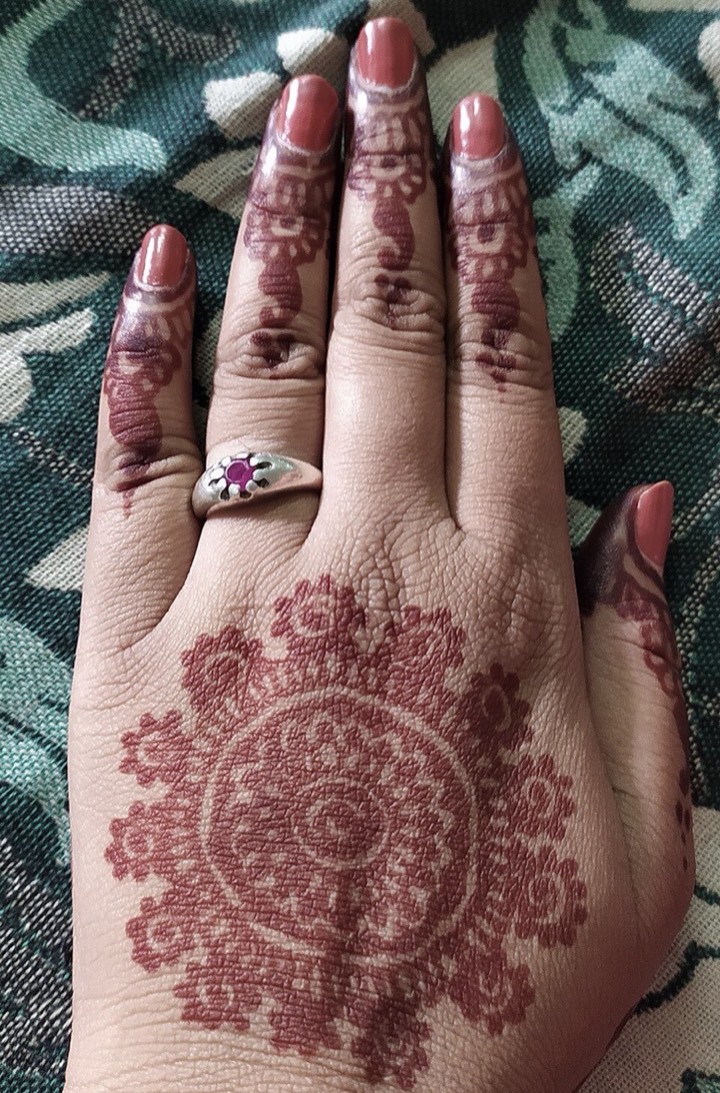
To draw the traditional motifs yourself: a book of classic mehndi designs and natural brown cones
Chosen from Amazon's best-rated, best-selling listings, then checked against the ingredient list. Prices refresh daily.

Mehndi Designs: Traditional Henna Body Art (Dover Pictorial Archive)
$9.95
as of Nov 24, 2026

Organic Leaves - Henna Cones 3 × 30 g Pack | Made from 100% Natural Henna Leaves | Ready-to-Use, Pre-Filled Cones | 5-Stage Filtered for Rich, Long-Lasting Color | Chemical-Free & Premium Quality
$7.59
as of Nov 24, 2026

Plantovika Henna Cones Made from 100% Natural Leaves | Fresh Ready-to-Use Pre-Filled Paste, Henna Tube | Dark Reddish Brown | No Additives | Long Lasting Color | Pack of 6
$8.49
as of Nov 24, 2026


Kaveri Henna Cones 12 Pack Ready to Use Henna Tattoo Cone Dark Brown Organic Indian Long Lasting Temporary Tattoo Tubes Color For Women - 10.88 Oz Pack of 12
$10.50
as of Nov 24, 2026
Affiliate links. Product prices and availability are accurate as of Nov 24, 2026 and are subject to change. Disclosure at the end of the page.
What the word "henna" means
In English, henna has four related senses. Wiktionary lists the shrub Lawsonia inermis, its fragrant flower, the reddish dye made from its dried leaves for temporary tattoos and hair coloring, and the reddish-brown color itself. The word is borrowed from Arabic حِنَّاء (ḥinnāʾ), the name of the tree. Wikipedia's article on henna gives the same origin and cites Merriam-Webster for it.
Go back one step further and the trail gets less certain. Wiktionary suggests the Arabic word probably comes from a reconstructed Middle Persian root meaning "to smear, anoint". The "probably" is theirs, and it matters, so read that as a likely origin rather than a settled one. Wiktionary also notes that "henna" and "alkanet", the name of a different dye plant, are doublets: two English words that come from the same source word by different routes.
The botanical name has its own meaning. The Natural History Museum in London explains that Linnaeus named the plant Lawsonia inermis in 1753. Lawsonia honors Dr Isaac Lawson, an eighteenth-century naturalist and traveller, and inermis means "unarmed", because the stems have no prickles.
What "mehndi" means, and other names for henna
Mehndi is the Hindi मेहंदी and Urdu مہندی (mihandī), which Wiktionary traces to the Sanskrit मेन्धिका (mendhikā) and dates in English to the 19th century. The Mehndi article on Wikipedia adds that the word entered Hindi, Urdu, Punjabi, Gujarati and Bengali. It says the word came to mean both the paste and the art of applying it. Citing A Dictionary of Urdu, Classical Hindi and English, it notes that mehndi can also mean the wedding celebration built around the application. You will see it spelled mehndi, mehendi and, in older English, mendi.
So in English today, "mehndi" can mean four things, as Wiktionary sets them out: the plant, the dye preparation, the decoration on the skin, and the practice of applying it as part of a bride's or groom's wedding preparations. When an American invitation says "mehndi night", it means the last of these.
Other languages have their own words, and some carry an extra layer of meaning. In Morocco, Wikipedia's henna article reports, citing Kelly Spurles's 2004 thesis on henna in Morocco, that people call the paste henna but call the designs naqsh, which means painting or inscription. In Turkey the henna night is the Kına Gecesi. In Afghanistan, Wikipedia records henna as "kheena". In each case the word names the plant first and the custom second, which tells you how closely the two are tied.
The plant behind the meaning
Every meaning henna carries rests on one chemical fact: the leaf stains skin. The Natural History Museum explains that the plant contains a copper-colored dye molecule called lawsone. When the leaves are crushed, lawsone is released slowly and binds to protein, leaving a stain on skin, hair and nails. The color is darkest on the hands and feet, because that is where keratin, a type of protein, is most concentrated.
That explains why henna sits where it does in so many ceremonies. It goes on the palms and soles, it shows up as a reddish brown that deepens over a day or two, and then it fades as the skin renews. A mark that is bright for a celebration and gone a few weeks later suits a rite of passage. How long yours lasts depends on the paste and the skin, and our page on how long henna lasts covers the factors.
The museum is also candid about how much is unknown. It says the origin and history of henna "isn't well-recorded", and that the plant is believed to have originated in the Middle East and North Africa before spreading across Asia.
What henna means at weddings, Eid and other celebrations
Here the sources agree more. Henna as a whole, rather than any one motif, has a well-documented meaning: blessing, luck and joy. Wikipedia's henna article says henna was regarded as having barakah ("blessings") and was applied for luck as well as joy and beauty, citing Edward Westermarck's 1926 study Ritual and Belief in Morocco. The Natural History Museum puts it this way:
"Henna is a symbol of joy in many religions, including Islam, Christianity, Judaism, Buddhism, Hinduism and Sikhism."
The same museum article says that in Moroccan Jewish practice, and later in India and Pakistan, henna on the couple was meant "to symbolically bestow the new couple with good health, fertility, wisdom and security", and that tradition held it would protect them from demons. Wikipedia's account of Afghan custom, citing George Monger's Marriage Customs of the World, says henna is held to bring good luck and happiness.
The occasions follow from that meaning. Wikipedia's henna article lists Purim, Eid, Diwali, Karva Chauth, Passover, Mawlid and saints' days, as well as births, circumcisions and weddings, as celebrations that usually included some henna across the region where the plant grows. The Mehndi article adds Hindu festivals including Teej, Raksha Bandhan and Navratri, citing a 2009 history of cosmetics. It also adds Eid al-Fitr and Eid al-Adha, citing Mary Packard's Henna Sourcebook. Among South Asian Muslims, it says, henna is done for Eid on Chaand Raat, the night before.
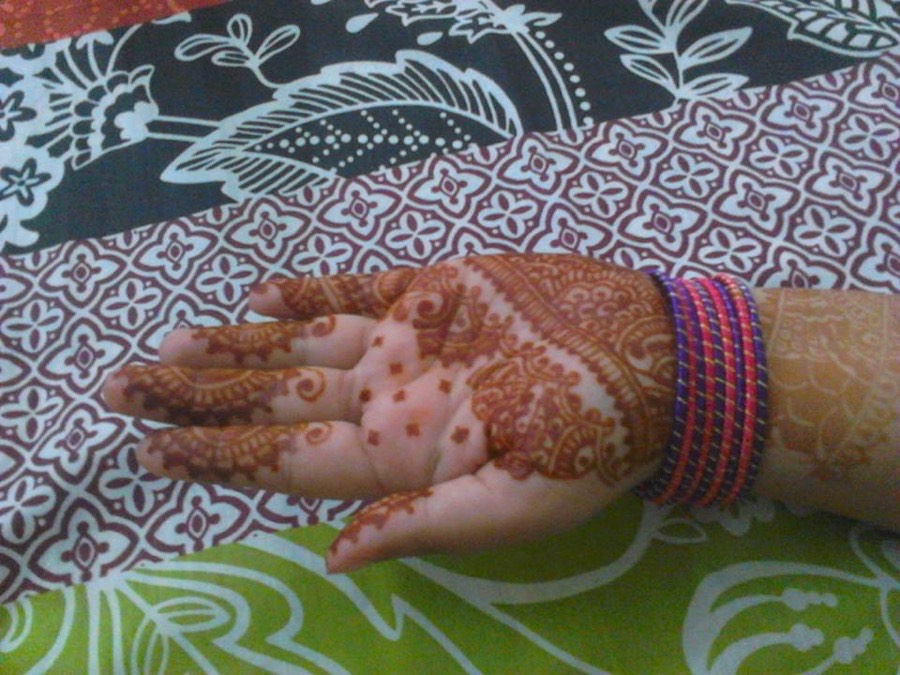

Weddings carry the most henna and the most meaning. Wikipedia notes that brides typically had the most henna and the most complex patterns, to match their greatest joy and wishes for luck. The bridal night has a name in many languages: Rasm-e-Heena in Pakistan, hina gisher in Armenian, Al-Ghumra in parts of Saudi Arabia. Our bridal henna designs guide covers the bride's own set. The wedding henna designs page compares how different traditions decide who receives henna, from the groom's pinky finger in Turkey to both bride and groom in Moroccan Jewish weddings.
The darker-stain saying
One meaning almost everyone has heard is that the darker the bride's henna, the more her partner loves her. Wikipedia's Mehndi article describes this as "a cultural joke" in India and gives no source for it, which is about the right weight to give it. Enjoy it as part of the fun of the night, not as a forecast.
The real reasons a stain goes dark are physical. The Natural History Museum explains that color is darkest where keratin is most concentrated, which means the palms and soles. Time matters too: Wikipedia's henna article notes that the longer the paste stays on the skin, the darker and longer lasting the stain. And Organic Leaves' instructions describe the color starting orange and deepening to brown over one to two days. A pale stain on the forearm, then, says something about the forearm, not the marriage.
Henna symbols, motif by motif
Now for the question most searches are really about: what the individual shapes mean. The drawn sheet below gives each of ten common motifs one of three tags. Green means a reputable source records a meaning for the symbol in Indian religion or art. Even then, no source we found says henna artists draw it to carry that meaning. Brown means only the motif's name is sourced. A dashed outline means we found no traceable source at all.
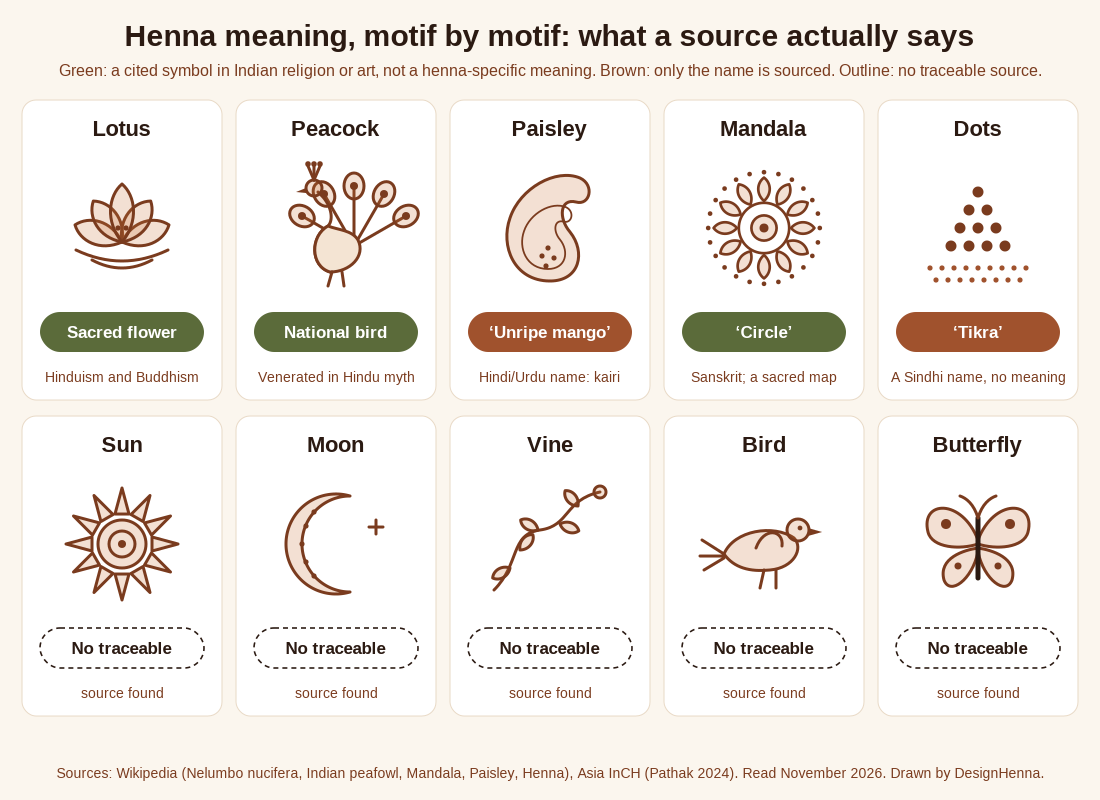
Lotus. The best-documented of the ten, though not as a henna meaning. Wikipedia's lotus article, citing Kew, calls it a sacred flower in both Hinduism and Buddhism, representing the path to spiritual awakening and enlightenment. It is closely associated with Lakshmi and Vishnu, and it is India's national flower. It is the usual centerpiece on the back of the hand, and our henna flower designs page shows how to draw it.
Peacock. The peacock is India's national bird. Wikipedia's Indian peafowl article cites the Government of India for this and says the bird is venerated in Hindu mythology. It also says it is often depicted in temple art, poetry and folk music, and that it is the mount of the god Kartikeya. In henna, the Henna article's section on Sindh lists mor, the peacock, as a traditional motif. The popular readings "beauty", "love" and "grace" come from design blogs without a source.
Paisley. Here the name is solid and the meaning is not. The design has many names: boteh in Persian (shrub or bush), kairi (unripe mango) in Hindi and Urdu, and ambi in Punjabi, from the word for mango. Anamika Pathak, writing in Asia InCH in 2024, traces the kairi from architecture to Kashmiri shawls, which it dominated from the 17th century. She notes that the mango tree, its wood and its leaves are still considered auspicious among Hindus. Wikipedia's paisley article is blunt that there is "significant speculation" about the motif's origins and symbolism. Some say it stood for the sun, a phoenix or an eagle. The common henna reading, "fertility", is not traced by any of these.
Mandala. The word is Sanskrit for "circle". Wikipedia's mandala article says that in Hinduism, Buddhism and Jainism it is used as a map representing deities. The Mehndi article says mandalas are drawn in the center of the palm, but it flags that line as needing a citation, and it does not say what a palm mandala means.
Dots. The same Sindh passage names tikra, "dotted", as a traditional motif. It cites a 2018 book, Sindhi Roots & Rituals. That gives us a name, not a meaning.
Sun, moon, vine, bird and butterfly. We found no museum, encyclopedia, academic or named-author press source for a henna meaning for any of these five. Vines are described as a main element of Arabic-style designs, but the line carries a "citation needed" tag and says nothing about meaning. The butterfly in particular reads as a modern addition. It is a fine thing to wear, but nothing we read places it in the traditional vocabulary.
The evidence table: who says what
This is the same information as the sheet, with the source for each row and how much weight it can bear. "Sourced, general" means a reputable source gives the symbol a meaning outside henna. "Name only" means just the motif's name is documented. "None" means we found no traceable source.
| Motif | Reading | Who says so | Confidence |
|---|---|---|---|
| Henna itself | Blessing (barakah), luck, joy | Westermarck 1926, via Wikipedia; Natural History Museum | Sourced, for henna as a whole |
| Henna at a wedding | Good health, fertility, wisdom and security for the couple; protection | Natural History Museum (Moroccan Jewish, Indian and Pakistani practice) | Sourced, for the custom |
| Lotus | Sacred flower; spiritual awakening | Wikipedia's lotus article, citing Kew | Sourced, general |
| Peacock | National bird; venerated | Government of India and Hindu mythology, via Wikipedia | Sourced, general |
| Paisley | "Unripe mango" (kairi), "shrub" (boteh) | Pathak 2024; Wikipedia | Name only; symbolism contested |
| Mandala | "Circle"; a map representing deities | Wikipedia's mandala article | Sourced, general |
| Dots | Tikra, a named Sindhi motif | A 2018 book, via Wikipedia | Name only |
| Sun | None found | Blogs only | None |
| Moon | None found | Blogs only | None |
| Vine | None found | An uncited Wikipedia line naming vines in Arabic style | None |
| Bird | None found | Blogs only | None |
| Butterfly | None found | Blogs only | None |
| A darker stain | "Your partner loves you more" | Wikipedia calls it a cultural joke, uncited | A saying, not a fact |
Two patterns stand out. The best-sourced meanings belong to henna as a practice, not to any shape drawn with it. And where a motif does carry a recorded meaning, the record is about the lotus or the peacock in religion and art, not about henna on a hand. Drawing a lotus may well bring those associations to mind for you and your family. No source we found says it is a code that artists or brides agree on.
Why most motif-meaning lists cannot be traced
When we searched for motif meanings in November 2026, every result the search returned came from a wedding vendor, a henna studio or a lifestyle blog. Not one came from a museum, encyclopedia or journal. The lists also disagree with each other: one says the paisley means fertility and luck, another fertility, abundance and prosperity. When readings shift from list to list and none cites anything, they are most likely copied from one list to the next, not drawn from a tradition.
That does not make them worthless. A meaning can be real in a family or a studio without ever being written down, and plenty of artists use these readings sincerely. The problem is the confident tone. "The peacock symbolizes love" reads like a fact, and a reader cannot tell it apart from "henna was regarded as having barakah", which has a 1926 study behind it.
Regional names are a useful middle ground. The Sindhi names mor, badak (duck) and tikra show that people named these motifs, and naming is evidence of a shared vocabulary. Names are still not meanings, though, and turning "the peacock motif" into "the peacock means X" is the step most lists take without support.
Choosing motifs when the meaning matters to you
If you want a design that means something, the most reliable source is the people in the room. Ask your mother, grandmother or the elders of the family which shapes they wore and why. Ask your artist what they were taught. A meaning passed down in your family carries more weight than a blog list, and it will be the one your guests recognize.
If no one has a tradition to pass on, choose for what the source record actually supports:
- For the meaning of the occasion, the henna itself carries it. Any design applied for a wedding or Eid carries the documented associations of blessing, luck and joy.
- For a South Asian look, combine the lotus, peacock, paisley and mandala. These four have the deepest roots in Indian art, even if their henna meanings are not written down.
- For an Arabic look, use bold vines and flowers with open skin between them. Our Arabic henna designs page has the layouts.
- For something personal, hide a name or initials in the lattice. That is a meaning you set yourself. The bridal guide explains where artists usually put them.
To draw the motifs yourself, the how to draw henna designs drills start with the shapes on the sheet above. The Dover book of traditional mehndi designs in the grid above collects many more.
What henna should never mean: a reaction
All of these meanings depend on natural henna, which stains in the orange-to-reddish-brown range. Products sold as "black henna" are a different thing. The FDA warns that they can cause dangerous skin reactions, and it says PPD, the chemical often behind the black color, is not permitted in cosmetics applied to skin. The FDA also approves henna itself only as a hair dye, not for direct application to the skin.
The American Academy of Dermatology lists signs of a reaction to a temporary tattoo, including redness, swelling, itching and blisters. These can appear up to three weeks later. Use only natural brown paste, patch test first, and skip it if you have ever reacted to hair dye or black henna. Our black henna page explains how to spot it. A symbol of blessing should not leave a scar.
Questions people ask
What does henna mean?
The word comes from Arabic ḥinnāʾ, the name of the shrub Lawsonia inermis, whose dried leaves make a reddish-brown dye. As a custom, henna has long been tied to blessing, luck and joy, which is why it is applied at weddings, Eid and other celebrations.
What does mehndi mean?
Mehndi is the Hindi and Urdu word for henna, from the Sanskrit mendhikā. In English it can mean the plant, the paste, the design on the skin, or the pre-wedding gathering where the paste is applied.
What does a peacock mean in henna?
No source we could trace gives a henna-specific meaning. What is documented is that the peacock is India's national bird and is venerated in Hindu mythology, and that the peacock (mor) is a named motif in Sindhi mehndi. Readings like 'beauty and love' appear on design blogs without a source.
What does a lotus mean in henna?
The lotus is a sacred flower in Hinduism and Buddhism, linked to spiritual awakening and to the goddess Lakshmi. That is the flower's meaning in religion and art. We found no source that says henna artists draw it to carry that meaning, so treat it as a likely association rather than a rule.
Does a darker henna stain mean your partner loves you more?
That is a saying, not a fact. Wikipedia calls it a cultural joke. How dark a stain goes depends on the paste and where it sits on the body: the Natural History Museum notes that color is darkest on the hands and feet, where keratin is most concentrated.
Sources
- Wiktionary — henna: etymology from Arabic ḥinnāʾ, senses (read November 2026)
- Wiktionary — mehndi: Hindi/Urdu from Sanskrit mendhikā, senses (read November 2026)
- Wikipedia — Henna: etymology (citing Merriam-Webster), cultural use, barakah (citing Westermarck 1926), regional customs (read November 2026)
- Wikipedia — Mehndi: etymology (citing Platts' Dictionary of Urdu, Classical Hindi and English), festivals, popular patterns (read November 2026)
- Natural History Museum, London — Tammana Begum, The henna plant: transcending time, religion and culture (read November 2026)
- Wikipedia — Nelumbo nucifera: religious significance of the lotus, citing Kew (read November 2026)
- Wikipedia — Indian peafowl: national bird of India, citing the Government of India (read November 2026)
- Wikipedia — Paisley (design): boteh, kairi and ambi names, contested symbolism (read November 2026)
- Anamika Pathak, Mango-kairi-kalka-paisley: Design in Indian art from architecture to textiles, Asia InCH, Issue 43, 2024 (read November 2026)
- Wikipedia — Mandala: Sanskrit 'circle', use in Hinduism, Buddhism and Jainism (read November 2026)
- Go Türkiye (Turkish Tourism Promotion Agency) — Turkish wedding customs: Kına Gecesi (read November 2026)
- Manufacturer instructions on the linked listing (Organic Leaves) — color development over one to two days (read November 2026)
- FDA — Temporary Tattoos, Henna/Mehndi, and 'Black Henna': PPD warning (read October 2026)
- American Academy of Dermatology — Tattoo skin reactions (read October 2026)

Updated November 23, 2026
Sukie is the editor of DesignHenna. She researches natural henna for hair, skin and brows, compares products against manufacturer specs and live Amazon listings, and updates every guide as products and prices change.
Keep reading
- Arabic Henna DesignsBold florals, flowing vines and the negative space that makes them work
- Back Henna DesignsNape to lower back, zone by zone, drawn by a friend and planned around the dress
- Back of Hand Henna Designs15 layouts, the flow rule that makes them flatter your hand, and how to draw them
- Bridal Henna DesignsStyles, the two-day timeline, what it costs in the US, and how to brief an artist
- Butterfly HennaSix drawn designs to copy, where each one sits on the body, and how to draw a butterfly in five strokes